Earning Ears / The index / Ep 07
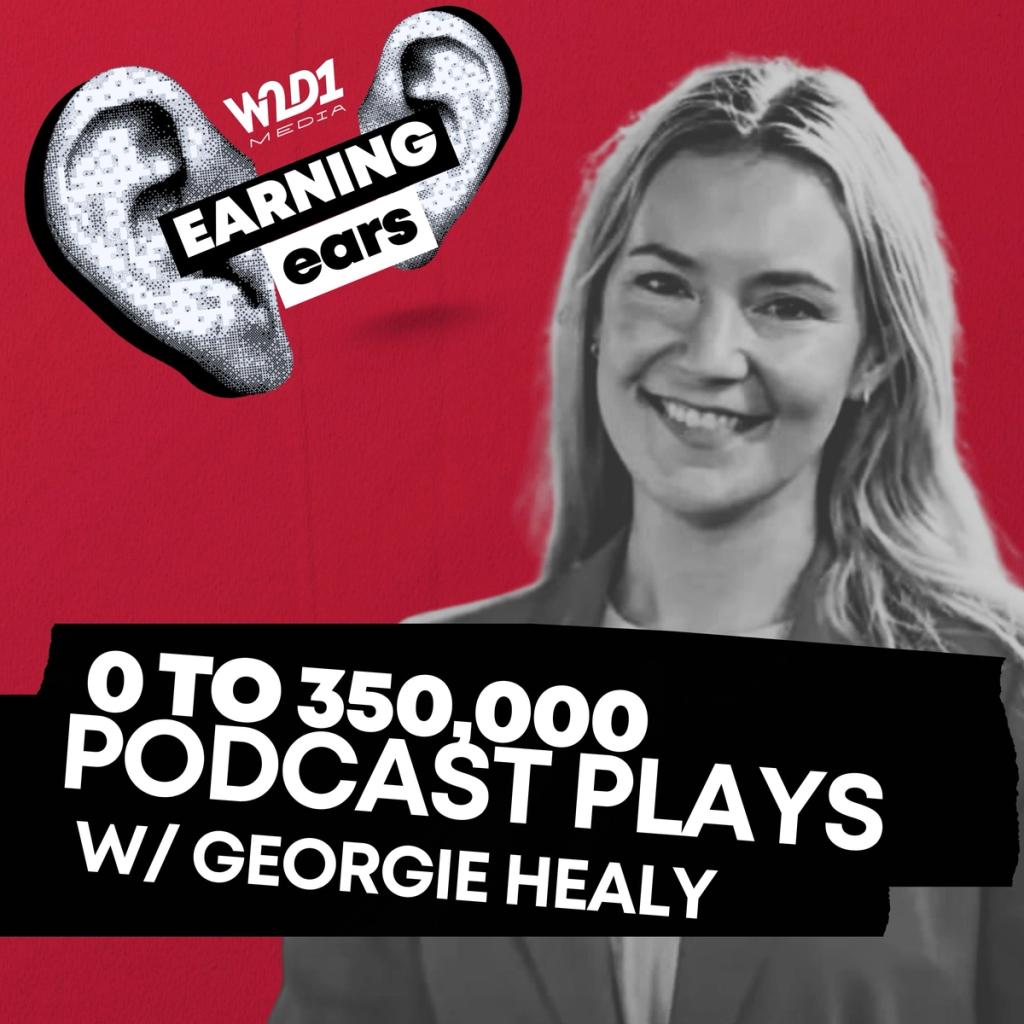
EARNING EARS · EP.07building In the Blink of AI to 350k downloads in 15 months
About this episode
Georgie Healy built In the Blink of AI from two shelved episodes into a show with more than 350,000 downloads in about 15 months. She and Adam Spencer break down the craft and the business of growing a podcast: why the early metrics lie, how to promote without the ick, the guest strategy that widened past AI technologists, and why confidence is not a prerequisite for starting.
Key takeaways
Ignore the early metrics: in the beginning, download charts only demoralise you. The more useful work is self-critique — listen back to your own episodes and fix the filler words, the interruptions and the habits that make you a weaker host.
Confidence is not a prerequisite: “Do not let confidence be the reason that you don't start.” Georgie wasn't confident early on either, and argues a more carefully crafted message often comes from people who aren't just excited to hear their own voice.
Consistency beats intensity — but don't burn out: publishing regularly throws out a net that pulls in new listeners, and the reps are how your skill finally catches up to your taste. Forcing an unsustainable schedule, though, is the fastest route to “pod fade.”
Reframe promotion as adding value: the self-promotional “ick” fades when every post genuinely teaches the audience something. Show up consistently, earn trust, and promoting the show stops feeling transactional.
Widen the guest strategy: In the Blink of AI evolved from pure AI technologists to AI thought leaders — journalists, ethicists, even ARIA-winning musicians — because AI now touches everyone. The test is listener value, not the best LinkedIn profile.
Build an ecosystem, not just clips: a newsletter gives a direct, measurable line to the audience; in person, the best promotion is other people introducing you (lead your bio with “podcast host”). The payoff shows up as LinkedIn growth full of CTOs, founders and execs — and doors to guests you'd never otherwise reach.
Resources mentioned
Georgie Healy is the host of In the Blink of AI, the Day One Network show she grew to more than 350,000 downloads in around 15 months. She's most active on LinkedIn, where she also runs the show's newsletter.
Shows and voices referenced in the conversation: Fat Mascara (Georgie's first-ever podcast listen), Startup by Gimlet Media, the deep-dive show Acquired, and Gary Vaynerchuk's “micro hustle, macro patience” philosophy. The In the Blink of AI intro music comes from Dan Hansen, drummer of ARIA Award-winning band Ballpark Music.
Georgie Healy: Please don't look at the metrics. You'll make yourself miserable. 8 hours of editing? Who has the time? You'll hate your voice, you'll hate the metrics, you'll hate the quality of your microphone, and you'll just be like, "Fuck this, sorry." You get used to hearing your voice in 1.5x speed. You learn so much more about yourself. You sharpen the hell up. Do not let confidence be the reason that you don't start. Welcome to Earning Ears.
Adam Spencer: It's great to have you here. It's been a while since I've recorded with an episode. How are you going?
Georgie Healy: Thrilled to be on the other side of the mic. I actually feel like, I feel like this is meant to happen in, in an alternative universe. I always wanted to see what it was like to be interviewed by you, Adam, especially after our long history.
Adam Spencer: So, well, don't get your hopes up, it's not going to be that great. Uh, I think I've done—
Georgie Healy: yeah, downhill from the intro.
Adam Spencer: I think I've probably done, I reckon, at least 200 interviews Uh, but it's been a while since I've done them, and so yeah, that's kind of— it definitely doesn't feel like, uh, you know, just jumping back on the bike again. I feel like it's a— it's— I needed to do a few.
Georgie Healy: Yeah, we were saying off mic, like, even a few weeks off of interviewing, I feel rusty. Like, it is.
Adam Spencer: Yeah, so let's just— let's just get past this awkward part and, uh, tell me about, like, your first discovery of podcasts and podcasting? What was like the first show that you've ever listened to?
Georgie Healy: Oh my gosh. So when I was in Detroit, I've never told this story before. I was in Detroit helping with, um, the headquarters were there. I was a consultant, a tech consultant, and I discovered a podcast called— don't laugh— Fat Mascara, which is all about beauty and which products are great. And it was an American show, these two New York hosts that were, I guess, working for like big fashion magazines. And it was my first entry into podcasting and they had like this great rapport. But really it was freezing cold. It was literally snowing in Detroit and I was coming from Brisbane. So, and, and the walk from where I was staying in Dearborn, Michigan to the Detroit factory, I would listen to that podcast on the way. And, uh, it was lovely.
Adam Spencer: That was my first intro. Very highly— like, what year was this?
Georgie Healy: It would have been like 2017.
Adam Spencer: Okay, so the kind of podcasting had been around, like I started listening to podcasts in around 2012 and I love this entrepreneur guy in San Diego, I fell in love with his podcast and his show was just produced in like his office at home with, you know, very kind of lo-fi stuff. Listening to that show, was it, how well produced was it and at that point like was it kind of, you know, top-tier stuff, people from NPR producing it, you know, or was it kind of a bit of in-house just figuring it out?
Georgie Healy: It was very in-house figuring it out. And oftentimes even the hosts themselves would say things like, I forget anyone's listening. Like, it was almost like they were just on a, on a, on a call. And it was pre-COVID, right? So people weren't actually necessarily used to recording digitally, virtually in that way, or having that many meetings that way too. So it did feel novel.
Adam Spencer: See, that's the podcasting that I fell in love with, that style stuff. It frustrates me, all of this, you know, really highly produced kind of, and all the radio stations getting involved and all that kind of stuff. That frustrates me a little bit. I really like the kind of just scrappy, like the early days, scrappy, figure it out. And it was just the amazing conversations and access to such specific knowledge, uh, that's, that's what made me fall in love with podcasting anyway.
Georgie Healy: I mean, I, I have a foot in each page. I don't know if that's an expression, I made that up. Um, I get why you need good quality visuals, and we obviously adopt them, but I, I agree with you sometimes, especially if that's how people are starting out, with high gloss high, you know, um, like 3 cameras, like all of this stuff. I feel like you as a host doesn't develop this, the critical interview skills, because you're kind of getting carried away with the aesthetic. And it's like, are you actually gonna be able to carry an hour-long conversation?
Adam Spencer: Yeah, I totally get why we are going the direction we're going, you know, YouTube, uh, video, every— as, as everyone wants to kind of, you know, up the game, up the game, you've got to kind of keep up. And so I think really great quality video and audio is just kind of table stakes these days. Now let's transition because we have talked now for 5 minutes and I, and me being a podcast host, I haven't even kind of given the audience the hook of the reason why they should be listening. But you are the host of one of the Day One Network shows. You're on the Day One Network at the moment. You're the host of In the Blink of AI, which has done over 300,000 or close to around roughly last time I checked about a month ago, 350,000 downloads. In about, I don't know, what is it, 14, 15 months or something like that since the show's been going. That's incredible. I mean, it's not like millions of downloads an episode, but you don't need millions of downloads an episode. We'll get there one day. Jumping from your walking down the street to work in Detroit, listening to your show in 2007, listening to the first show you ever discovered, to getting behind the mic at Linkable AI, what made you want to do that? Like, where did that curiosity— or like, why, why did that happen?
Georgie Healy: I'll admit to you, Adam, when we first talked about it, um, I had been wanting to get behind the mic for easily a year at least that I was aware of, consciously aware of. It was two things. It was one, an admiration for these hosts that do such an incredible job and add so much joy or knowledge or awareness, or like, it just you know, a layer of entertainment to my life, that I respected them and admired them and wanted to emulate them. And the second reason is, frankly, I just wanted to see what goes behind it. Like, technically, what does it take to build a show? Now, I know nowhere near the end-to-end level that you do, but I did just want to know, like, if I was to do this, what would that look like and how hard is it? Um, so there was a curiosity as well.
Adam Spencer: How hard has it been? Let's give the audience that. How hard has it been to build the show?
Georgie Healy: Like, you are not telling me to say this. I did try and do it on my own. I got a Podtrack, which looks like this. I've still got it to help me record on location. I was a university postgrad student. They let me use their sound booth. I had that for free. I had the network in startups. I could have like I already had everything at my disposal, but the editing process is what put me off. Like 8 hours of editing, who has the time? Like I had a full-time job and to have to show loyalty to listeners, I just couldn't commit to it. I recorded 2 episodes with 2 amazing people. It never saw the light of day. It's really hard. It's not like that, all of that at my fingertips, which is already hard to come by. It was still another layer before you could actually remember.
Adam Spencer: Now you, you had the intro track as well recorded by a musician ready to kind of go as well. Um, oh wow.
Georgie Healy: Ballpark Music is a famous ARIA Award-winning band, and I'm friends with, uh, Jen in the band, and I got introduced to a drum— the drummer of the band. So you'll still hear in the Blink, uh, outro, like, thanks to Dan Hansen. That's who that is. It's the drummer.
Adam Spencer: Aria Award winner. We need to like mention that more.
Georgie Healy: We need to, I know we need to, I know we really do.
Adam Spencer: So yeah, it is hard, I guess, you know, especially the part, there's a lot of pressure for people to, you know, hear the advice, you know, to grow a show, you need to be showing up weekly at least. That is very daunting. Most of— and I agree with that in the sense that it is very hard to grow an audience. And I think the best way to grow an audience is to be throwing out that net as often as you can, i.e., so that you can hopefully— every episode is a net. It will hopefully pull in an extra listener that, you know, hopefully stays. And so I agree in that sense that you should be publishing regularly. But also the other part of it is just repetition, getting those reps in, making those, as MrBeast says, you know, there's one percent, I think he says, there's one percent improvements, you know, every video, make 100 videos before you even started thinking about, you know, why am I only getting 100 people listening? So for those two reasons, I think it's super important to publish weekly, but I don't think it should be forced on people because that is the quickest way to just pod fade, to just get, to just get overwhelmed by it all trying to keep up with it.
Georgie Healy: Yeah.
Adam Spencer: Oh, you don't know that?
Georgie Healy: Yeah, the—
Adam Spencer: because a lot of people just kind of go really hard into it to start with, you know. They get 6 episodes in and they've put in a lot of effort, like you see those 8-hour edits, while also juggling a full-time job and trying to find guests and booking that in and making sure that every— the production looks schmick. And then, you know, 6 episodes in and they're getting, you know, 80, 60 listeners an episode, and it just doesn't make sense. It's just so much work for—
Georgie Healy: yeah, if that, if that. I'm sure I got less than that in the early days. And, you know, I get asked a lot— I'm sure you definitely do, Adam— about, um, like, you know, I'm looking at all my data and my statistics and I've got it ready, and I'm almost like you're looking at the wrong thing in the early days because all that's going to do is disenfranchise you. What you should be focusing on, my hot take, is yourself. Listen back to the episodes. How could I be a better host? There's all sorts of things I was doing the early days that, you know, some I've really improved on, some I still need work on, and it's my own self-critique. Don't, uh, interrupt the guest. Like, uh, You don't even just like filler words. I used to go, yep, yep, uh-huh, yep, yep. And I'd listen to myself like, stop it. Things like that, you have to listen to your own episodes. And, uh, looking at the data isn't helpful, but trying to make the best show you can possibly make is helpful.
Adam Spencer: Yeah, I, I'm trying very consciously not to do it now that you've mentioned it, that they're like, you, you have to— yeah, you have to be Seeing to be actively listening and actively listening, but doing it with those non-verbal cues instead of the yeah, yeah, yeah, yeah, yeah.
Georgie Healy: You see me doing it, right?
Adam Spencer: I really like the nod. I just like the little nod to show you that I'm listening. Okay, that's great advice. So for someone brand new that is thinking, I'm sure you probably have a lot of people coming up to you now saying, you know, interested in starting their own podcast. After they've seen what you've done, what would— what advice would you give them in those very early days before they kick the show off?
Georgie Healy: My first, my first thing is, do you listen to podcasts? You and I clearly are huge fans of podcasts. We really respect the medium, we respect the hosts, we admire the format, and we probably have an opinion on what we like and don't like. You really need that before you start. I feel these people that are like, I'm gonna be the host of a podcast because it gets me a network, it gets me brand exposure. I look like a thought leader. AI is a thing. I want to look like I'm in AI. Like, that's not the reason to do it, because then when all these hard parts that we've talked about come up, which they inevitably will, you don't have any joy and love and passion for the, for the medium, I feel. So that's my first thing is knowing what you love and being an actual fan. And then the second thing is it's really not about if you can have a podcast, because I do genuinely think most people could become great hosts if they've got that, like, level of passion. Uh, do you have something interesting to say? Because it's not even about the topic, but do you have a great network that you want to use if you're doing interviews? Do you have an interesting topic that you want to talk about? Can you do that week after week? And still have, like, I'm really lucky that I'm in the AI space. It's moving so quick. There are always so many things to speak about and so many experts to talk to and still have stuff we've never touched before. Whereas not everything is so evergreen.
Adam Spencer: I love that you brought up the, you know, guests in the, in an interview because there are a lot of different formats a podcast can take. An interview one is, is obviously the most common, but also very hard to do well. Just thinking about the guest selection at the moment, like when you started the show and then how is your— how has it also evolved over time, your, your guest selection and your guest strategy?
Georgie Healy: Strategy is a strong word for what it was initially. It was people I admired in the industry, like as simple as that. Um, and you know, I had incredible guests from day dot, and I stand by that. Like, these are incredible people doing incredible stuff, but, but the, the name make sure it founded. And, and, you know, what the market likes, you know, 14, 15 months ago is not necessarily what the market's interested in now. The SaaSpocalypse that's happening right now, you know, everything— everyone was obsessed with B2B SaaS, you know, that long ago. So, so even though the guests were always amazing, you know, the guest philosophy and strategy has changed somewhat. And, you know, I have had incredible guests like Tracy Spicer, who's a journalist. I'm evolving my strategy to be not just AI technologists but AI thought leaders. She wrote a book on AI but happens to have, you know, that humanities background. Ethics experts, ARIA musicians. AI is really affecting everyone now in such a meaningful way. And so my strategy is how can the listeners get the most value from my guests now, not just necessarily the person that's the best LinkedIn profile.
Adam Spencer: Uh, I just learned a new word, SaaSpocalypse. I didn't know that was a thing. That's a cool word. That's better than Podscape.
Georgie Healy: It's coming, it's coming to Australia.
Adam Spencer: Okay, so the— and I think that's really smart to kind of take it just the outside, just the kind of AI founders and operators to people, everyone that's getting impacted by AI. And that is true. I think that's an advantage in your show is because AI is so fast moving. It's just, there's just so much to talk about. Moving on to the growth of the show, which I think has been pretty phenomenal. What have you seen that has— because I think when a lot of people start a show, all they do is they post to social media. They post that one clip on their personal LinkedIn or whatever. And that's their promo done. Maybe they post some audio, you know, some clips and some audiograms. But you have, now tell me, I don't know if this has been strategic on your part, but you have kind of got this whole ecosystem going. You've got your newsletter now, you're always at events, you're kind of, and you're very outgoing, and I think that is a huge advantage as well, growing a show. What has been your approach? What's been working for you to grow the audience?
Georgie Healy: Early days, I did it while breaking out into cold sweats as a means to grow the show. I did not want to post anything because I felt icky. I felt like it was too self-promotional. It's already really hard to have your face and your voice— like, everyone hates the sound of their own voice, let alone video clips of themselves. And then for me to promote it on top of that on such a public forum— terrifying. Hated it. Did it because Otherwise the show dies, like no one will be aware of it, let alone watch it. And so, um, my initial tactic, which I don't have to think about anymore because that muscle has been developed where I just don't get as shy anymore, was how can I add value? If I'm going to promote my podcast, how is this LinkedIn post genuinely going to teach people something? How does the, the LinkedIn post itself genuinely make people like think a little bit, and then I felt less bad about doing it. I was like, I genuinely think this will help you if I share this. And then week after week showing up and being consistent, your audience trusts you and you can start posting about other things. And then when you promote the podcast, it doesn't feel like this transactional thing anymore. And now I post the most ridiculous stuff on there as well as the podcast, and the community kind of somehow like takes it all in.
Adam Spencer: Has there been any offline, um, you know, because obviously it's an online medium, you know, a podcast, it makes sense to just promote it online, but is it, but I think the real 1% growth increases are all the little things that you can do offline as well. Is it, have you seen that you know, just talking to people. And I don't know how else you're promoting it offline, but like, is there, is there anything else working that isn't digital?
Georgie Healy: Well, just a quick anecdote. I think the highlight of like my year last year was I was at, um, Google has this flagship event in Sydney. And you know, for a very long time I attributed any success to myself with the brand power that is Google. That's the only reason anyone cares about me is because I work at Google. And I was at the Google event and someone came up to me that I'd never met before and they said, oh, you've got that podcast. I'm used to hearing your voice in 1.5 speed. And I was like, oh my God, you should have started talking really fast. I just thought that was the funniest thing ever. I know, I was like kind of weirded out because I was like, are you insulted by that? What is that?
Adam Spencer: They're trying to listen to you faster?
Georgie Healy: Well, no, but also, I know it's a long-form podcast. I kind of get it out of them. I'm like, okay, if you need to listen to it in half an hour, I get it. But, uh, it was really nice because I because like normally I feel like it's a one-way, like, I've got a podcast, you should listen to it, tell me what you think. And people are really nice about it. But, uh, yeah, it— that was like my first ever, oh my gosh, you know me out of that. Um, but to actually answer your question, how I promote it in person, you know, your best promotion is always through other people that listen to it. So if you get other people to introduce you, and whenever someone asks my bio Uh, they could talk about Google, they could talk about 15 years in tech, they could talk about other things. I'm like, no, no, no, number one, hosted In the Blink of AI. And then people forget the rest. So that's how you get, like, even if you go to an event, you know, even if you work somewhere full-time, right underneath it, podcast host. And then, and then start the, the, uh, conversation.
Adam Spencer: Anything that you have, this, this, this question may be cut because maybe everything's just been win-win-win, but has there, has there been anything that you've tried that just hasn't worked to to grow the show?
Georgie Healy: Like, don't cut anything. Because honestly, when people ask me about podcast metrics, I'm often like, please don't look at the metrics. You'll make yourself miserable. Like, even now we have been doing it for over a year, and I know because you told me and everyone tells me podcasting is a long game. My favorite shows like Acquired, 7 years in before they even quit their full-time job. Jobs. Like, these are long games. And so, like, if I'm honest, the things that aren't working are working, which is slower than I would like. I would like to be a household name. We're biggest show in APAC, maybe. Like, what's that? Like, I want to be bigger. I want to be on the tech charts. I want to be huge. And so there's a frustration with how slow it can—
Adam Spencer: oh man, my head is just going in a million different directions. I love that ambition that you have to be at the top of the tech charts because I think, oh man, how am I going to talk about this? Being the founder of the Day One Network, I'll just say this, not all of our hosts are that ambitious and I really see that as a difference. I really see that passion that you have for the show to actually be translating to how fast the show grows. And, and I think I wish I could instill that in everyone that wants to start a podcast, is that it's not just a side hustle, it's not just this fun thing that you do on the weekend or after work. If you want it to go somewhere, you really have to put your entire self into it. And I see that again and again with you, and I think that, that has made a big difference.
Georgie Healy: I've liked our relationship for that reason, Adam, because when we started it, I didn't feel the pressure. So, so two things can be true. When you start the pod, if you put too much pressure on yourself, you'll, you'll hate it. You'll hate your voice, you'll hate the metrics, you'll hate the quality of your microphone, and you'll just be like, fuck this, sorry for swearing. But if you can— yeah, thank you. But if you can, uh, be okay in that messy early stage with— frankly, like, I really appreciated having a team at day one to be like, guys, give me brutal feedback. Like, we were really honest with each other, but I at least had people to vibe off of. No, that was really good. I really liked that episode. Um, you know that it meant something when you guys said that that was really good because we'd also seen when it wasn't the best, or when I gave you horrible audio quality and you had to somehow polish a turd. And I was like, I'm so sorry, I don't know why it was such shit quality. Please fix, like, please fix, and just dumped it at you guys. And we could turn it into something that I was still proud to publish. So it's a long rambling way of saying you need to be ambitious to get it to golden. But I also think that in the early days when you're maybe like— not proud isn't the right word, but you're not— it's not where you want it to be, you, you feel like—
Adam Spencer: I used to listen to— again, a bunch of things come to my mind right now. One, I used to listen to this show called Startup by Gimlet Media. You've probably heard of Gimlet, guy used to work for NPR and his mentor I think was Ira Glass who used to say, you know, in the beginning you'll have this amazing taste for what you want to create. In your mind, you know exactly how you want it to sound and be, but because you've not done the reps and you've kind of, you haven't built up that muscle, you haven't built up the tools, what you create is just not going to match up with what you want to be. And it just takes that, that rep and that— you got to suck before you're good. And you just got to keep doing it. And eventually your skill will match your taste. And I think that's relevant to what you were just talking about. And then the other thing that comes to my mind about— and I love that you brought this up— is, do you like Gary Vee? Have you ever looked at any of his content?
Georgie Healy: Oh, how do I answer that in a sentence? I think he's brilliant, but like, I stopped listening because I felt like it was too sensitive.
Adam Spencer: I think very early on his stuff was great. I think very, yeah, I haven't listened to him for years, but I loved, I love this line that he has, which is, I'm going to mess it up, something about micro hustle, macro patience. Where in the short term you've got to just get in there and suck and, you know, really work hard. But it's going to suck for a long time, so you have to be patient for a long time. You've got to want to be at the top of the tech charts. You've got to do everything it takes, but it's not going to happen in a week, a month, a year. So you need to do everything in the short term without getting that reward, but it'll eventually come if you keep doing those micro things. That's how I translated that anyway.
Georgie Healy: Fully agree. And I love that micro hustle. I mean, let's remove the fourth wall for a second. Literally like yesterday in our Slack channel, in the Day One Slack channel, I have an idea of a certain kind of show within the Blink of AI podcast, not changing the interviews, but I'm like, guys, I am desperate to try this new format. And it's very yes and, and you know, like I put out part 1 of 2 and I'm like, guys, tell me what you think. And we've still got that kind of hustle culture a year and a half in. I think if you ever lose that, like, yeah, I think you have to constantly be like, how do we make this even better?
Adam Spencer: But isn't it frustrating? Like, yes, you've, we're building something here. Like you've built something amazing with Blink. I'm trying to build something. Amazing with Day One, but you've always got to be innovating and hustling and trying to figure out, but then nothing is ever truly finished. Everything is always messy. And I find that so frustrating.
Georgie Healy: There's so many loose threads. And like, even this concept that we're trying, you know, 6 months I've been wanting to do this and I'm like, well, we can't do if it's too shit because we've built like this beautiful consistency in the show. So let's not throw a grenade in there, but then how do we innovate while not— like, yeah, it's exhausting to have that constant strategic—
Adam Spencer: do an episode on, um, in, in like a bit of a homage to Acquired. I could do like a really kind of deep dive, um, AI style show, like, like not what they've done but with the Blink of AI flavor. Uh, that'd take a lot of editing I'm obsessed with them.
Georgie Healy: I, yeah, no, but I'd do it forever.
Adam Spencer: Um, where are we going to next? We've kind of talked about, or asked the question of what didn't work. We've already talked about what has worked. What else do you want to try? What else, do you have any experiments in your mind to grow the Blink of AI brand in the future? What's coming?
Georgie Healy: You can't tell all our secrets, Adam. We can't tell everyone the secrets. We've got something big coming. Yeah, we've got something big coming. But I think it's not a secret that we have smashed the Aussie ecosystem. We've really done a great job of Blink in the Aussie ecosystem. I can see it because we get tagged all the time, you know, from people that I don't know. You know, this morning I had, you know, someone say they were at the Easter long weekend and they had streamed the show because it's long form, you know, it's episodes. So you need like long drives. It's great for and things like that. And I'm constantly surprised and delighted by that. But I think we need to be pushing bigger and that means in other markets, if I'm honest. And the show shouldn't be just a great little hint there.
Adam Spencer: I know this is— your show is a little different in the sense that like when we work with Blackbird and we're trying to grow our client roster to work with a lot more investors as well and a lot more business, a lot more kind of startups and scaleups. So when they start a show, it's really got to be tied to deal flow and leads and how it helps grow, achieve business objectives. For you, how are you measuring, um, you know, whether or not you should continue to do the show? Like, what are the kind of KPIs that you're measuring your show against for yourself?
Georgie Healy: Yeah, you mentioned the newsletter recently, um, like in the show, and the newsletter is great, right? Because a newsletter, you can see who's clicking what and how many people have viewed it, but also their emails and like this incredible stuff, which is really great. And with podcasts, it's like Well, we don't know where that stuff is going. We don't— we can't draw a clear line, a red thread between listeners and where they come from and how, like, whether they're decision makers or not. But what I have noticed with the podcast is it's grown my LinkedIn. And with my LinkedIn, I'm noticing trends of their decision makers, their CTOs, their founders, their execs. These are the people that listen to the show.
Adam Spencer: Cool.
Georgie Healy: And you know, we've got the Blink podcast page on LinkedIn and we can see that. But also anecdotally, it has opened up so many doors because frankly, guests want to be on a podcast and they want to be interviewed by, by a safe pair of hands that is going to ask great questions that listeners genuinely want to hear and not just be a sales pitch, but also you know, not paint them in a terrible light where they're like, why did I do that? You just made me look bad. And so I've grown— like, the, the people I've had on the show, the VP of Dropbox from San Francisco, people that are never in Australia, that they're coming to Australia, they want to be on the podcast. And there's things like that where it's like, without the podcast, there's no way they're talking to me. Like, I'm great, but like, not that great.
Adam Spencer: Yeah. Um, yeah, yeah, I'm loving— I love that you've started the newsletter. And yes, that's— you, you get a direct line to your customer, to your audience, to your customers, your direct line to your audience. And, and yeah, it could be customers. You get to see who they are. And then that, that's, yeah, very hard to do with the podcast. Actually, you can kind of get a bit of a blurry idea of who's listening through, like you've said, LinkedIn. You can see the CEO, product managers, people in IT industry are listening or engaging with my content. But it's really great to see people's emails sign up and, you know, you can email them and say, hey, you listen to the show, do you want to have a chat? You know, and that's really cool.
Georgie Healy: But can I also say, tell me if you think I'm wrong, but if I'm subscribed to a Substack or a blog of any sort I might really admire that person. I might really, really be a huge fan of them. There is something different about hearing someone's voice. I feel like the connection is stronger. I, I strongly believe that just because you can't tie a direct link doesn't mean that that isn't a strong relationship.
Adam Spencer: You don't need to ask me that twice because I definitely think that podcasting, long-form video, is the, is the best way to grow a, you Unfortunately, it's kind of like a one-way relationship, but like so much trust, so much, so much trust from, you know, and that's why the people are just going to sign up to your email list when they get the chance because they've listened to you for so long and they just trust you. And I don't think anything does it better than a podcast, but I'm very biased. Yeah.
Georgie Healy: Yeah, I mean, but, but I think the listeners that might be like, of course we would say that, we, we do what we do. Think about it. Like, think about the journalists that you might read a news.com article versus the people that you listen to on a podcast. I bet you do feel a warmer connection with the ones that you listen to on a podcast. I just, like, sanity check that one if you're listening. I, I strongly—
Adam Spencer: yeah, you read an article and a lot of the times I don't even look at the byline. Like, I don't even know who's written it, and I never think of them or read another article they've done ever again.
Georgie Healy: Yeah.
Adam Spencer: But you listen to someone for 30 minutes and you learn something from them and you go hunting them down for the next episode and then that just compounds. Yeah, I love podcasting.
Georgie Healy: Exactly.
Adam Spencer: So for people, we might start to wrap this up now. If you've, I think we've covered a lot of ground. I hope that we've talked about stuff that's been helpful for like if there's someone out there thinking about starting a podcast. But as I mentioned, you know, I'm, we've got the Day One Network and then we've got WTD1 Media. I really want to be able to do what we've done for you with a, you know, a lot of other people in Australia and in the tech ecosystem. But what, what advice, this journey that you've been on, why should someone in your mind, how can a podcast help them? How can— why should someone start one?
Georgie Healy: Honestly, it is— I, I have had my career as a minimum transformed, but also my confidence transformed in the process, because there is nothing more humbling than, than building and creating a podcast from the ground up of the vision you want with the guests you want, and then having to promote it. Like, the end to end of that, really humbling. But what happens in the process is you learn so much more about yourself you sharpen the hell up, you know. You can't, you can't phone it in, or it's very obvious. You are forced to learn about a person, an industry, uh, a, a, a new topic. So I'm— I feel like my brain is sharper because I have to learn about the energy industry one week and then, uh, copyright law the next week. Like, I feel like you get sharper in the process, and then And frankly, if you've seen my LinkedIn journey over the last year, my, my growth has been insane, incredible. But my, my confidence has really— like, before I joined the call, I just posted the most random stuff, and I'm like, I feel— I backed myself. Like, the journey has been incredible. I think podcasting does so many more things.
Adam Spencer: Andy, whoever is listening and editing this episode It's about 3:45 on a— what are we on? Tuesday afternoon. Can you go on April 7th? Can you go on to Georgie's LinkedIn and grab those screenshots of whatever she just posted and put them up?
Georgie Healy: You'll know when you see it.
Adam Spencer: We could do an entire other episode, I think, on your— I've already used the word phenomenal in this episode. I need to think of another word. I don't know. No, I just didn't want to show people how small my vocabulary was.
Georgie Healy: Um, I think I butchered it too, mate.
Adam Spencer: Your LinkedIn growth is incredible. Is that one good enough word? And good enough word, incredible. That's a separate episode altogether, like what you've done there, like, and how you've done it. Like, I am gobsmacked. But I, I shouldn't admit this on, on air probably, but like Generally speaking, social media is a bloody enigma to me. I just don't get it. It's not so much an enigma as it is I just hate it. I just can't do it very well. It just takes so much willpower to get on there and do it. But you're just smashing it out of the park. And I think that ties back to like your love of people. I'm not saying I don't love people, but your love of people and you're like wanting to help and talk.
Georgie Healy: Yeah, no, I love the social.
Adam Spencer: I think that really helps as well, that you love being on there, um, and doing it.
Georgie Healy: I get this a lot. I get this a lot, and Adam, like, uh, like, oh, you're killing it on LinkedIn. But, but like, I wanted to kill it on Instagram. Just my audience on there is like, sure, like 3 likes. So it is funny, isn't it? Like, it depends on the medium. I'm like a TikTok girly on the inside, but just no followers.
Adam Spencer: Once you get your LinkedIn up to a million followers, you just start promoting the hell out of your other social channels on there and get one.
Georgie Healy: Um, sweet show, but yeah, I'm hot now, guys.
Adam Spencer: Haven't we— to just kind of really bring this home, I like to— I always like to ask this question at the end, just in case. What, what haven't I asked you that you really wanted to talk about today? What, what is something that could have— that could be really useful to someone that's wanting to grow their personal brand, but maybe I haven't asked you that question?
Georgie Healy: The most important thing is that it's not about being a confident extrovert. You do not need to be someone that thinks of themselves as a public speaker. In fact, if anything, you're probably going to have a more carefully crafted message if you're not just excited to hear your own voice. Do not let confidence be the reason that you don't start. Think of all the things that, that a podcast or, or being more out there could do for you, and what you might be leaving on the table if you don't try. I strongly, strongly think that that is important to keep in mind. And, uh, I wasn't confident at the beginning either.
Adam Spencer: No one really is. Thanks, Georgie.
Georgie Healy: I love this next night.