
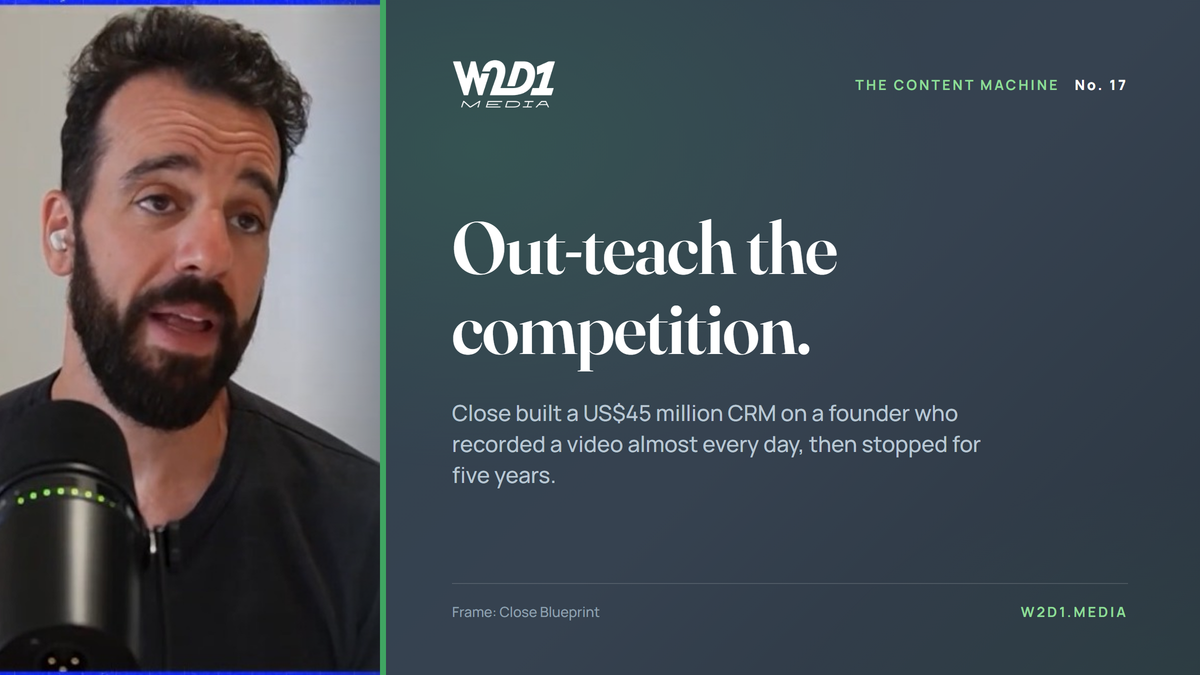
Close launched in January 2013 with six people, no search advertising, no search optimisation and no outbound sales. Its founder decided to out-teach the competition instead: a video almost every day, a writer turning his voice memos into posts, the posts into books, courses and a podcast with more than five hundred episodes. When new trials were asked how they heard of Close, half said the content. The company passed US$45 million in revenue in 2025, profitable and self-funded. Then the founder admits he stopped for five years. Here is the machine, and the gap.
The Content Machine is a column about startups and scaleups that run content as a system: what they make, how often, how it is reused, where it goes, who makes it, how it is measured and what it moves for the business. Close is here because its system was a person, which is the most common content machine in startups and the least often written about honestly. Steli Efti has written about it honestly, including the years he stopped. Every figure is attributed to the person or document it came from.
The premise
Close sells a customer relationship management system for small sales teams, with calling, email and, lately, an AI assistant built in. Steli Efti is the co-founder and chief executive. The company's own about page says it is "self-funded and profitable", built "without outside investors", with "120+ people. 100% remote." and "11,500+ sales teams" as customers. Efti told the Mixergy podcast in June 2025 that "we just surpassed, uh, 45 million, uh, in, in revenue", that he expected to end the year at "the 50 million mark plus", and that "we've been growing profitably for over a decade now." He also said "we raised a tiny angel round when we were doing something completely different", so the honest wording is self-funded after an early angel round.
The machine, in one paragraph. A founder who recorded a sales lesson on video nearly every day for two years; a writer who turned his ten-minute voice memos into blog posts; those posts turned into free books, email courses and gated guides; a podcast with Hiten Shah that ran to more than five hundred episodes; guest articles on TechCrunch and Mashable; and a company that asked every new trial where it came from. Today the site carries 956 blog posts by my count of its sitemap, nineteen free resources, a Monday newsletter called Dialed-In, and a video series called Blueprint in which Efti explains the method. The one piece to look at is the Blueprint episode on founder-led content, which is the company describing its own machine.
How it started
The strategy was a refusal. Efti told the SaaS Club podcast in the company's first years: "We don't do any SEM, we don't do any SEO." And: "we don't even do outbound sales." And: "Everything we've been doing since day one has been inbound sales." The company was "six full time people" plus a freelancer or two, had "launched Close IO in January 2013", and had decided to "out teach our competitors". In a 2019 interview he gave Growthramp the reasoning: "We first looked at paid ads, but realize we would not outdo them here." Public relations was the same. "we decided to go all-in on out-teaching our competitors." And: "Most of our competitor's content sucked."
The method was volume from one mouth. In the Blueprint episode Efti describes the early years: "for the next two years, I think almost every day without an exception, I recorded a video." The videos were "sometimes 10 minutes, sometimes 50 minutes, sometimes just five minutes". He would record "right after a call with a customer", while the problem was fresh. The writing worked the same way: "I'd record a 10-minute voice memo, stream-of-consciousness style", and "Within a day, my writer would turn in a blog much better than I could have written alone."
The first measurable piece was an email course. On Patrick McKenzie's Kalzumeus podcast in July 2014, Efti said of the lifecycle course McKenzie had helped shape: "I don't know how many thousands we're making more every month because of it, but it's a lot, so we owe a lot to you."
How the machine works
One recording, every format. Efti's own description: "We were able to turn any YouTube video into a blog, podcast episode, and gated content like ebooks," "which allowed us to sign up subscribers for more of our content." He adds that the team "organically stumbled onto a practice now known as 'content repurposing'". Brad Smith's 2019 account on Codeless gives the chain: "The blog posts then turned into eBooks, email newsletters, tweets and all kinds of other form factors", with the aim of "generating good quality from high quantity raw material at the beginning."
Borrowed audiences first, owned audience second. Smith records that Close "would publish on TechCrunch and Mashable quite regularly, as well as a bunch of sales focused publications", at "probably two guest posts per month" in the early years. The Startup Chat, Efti's podcast with Hiten Shah, began in 2015 and ran to more than five hundred episodes by its last in December 2020, per the podcast directories.
The free library is the funnel. The resources page today lists nineteen items: a 30-day Startup Sales Success email course, The Startup Sales Playbook at "90 pages on finding and closing customers", The Follow-Up Formula in a 2017 edition, a bundle of "19 templates, scripts and books. One download.", and the rest. None carries a download count. The newsletter, Dialed-In, goes out every Monday; Close publishes no subscriber figure.
The measure was a question at sign-up. Efti, in the Blueprint episode: "for the first couple of years, we didn't have great attribution." The recurring internal challenge was "where's the marketing dashboard" that proves content contributes. What they had instead was the answer to one question. "when we look at some of the best customers we're acquiring, how did you hear about us the first time?" And: "we would consistently hear when we would ask new trial users, how did you hear about us? It was only two answers. Pretty consistently, half of them would say the content". He adds that "we heard the results every day from our customer's mouth, so it was not difficult to believe in the ROI".
Then the founder stopped. This is the part worth the instalment. Efti says it has been "four years, if not five years" since he did much content at all, and on the Startups for the Rest of Us podcast in March 2025 he said that "people eventually pressured me into our corner at the company and said, you have to get back in the game." The company kept publishing without him; the blog's ten most recent posts in the autumn of 2026 came from five other names, and Ryan Robinson, who says "I'm the head of content at Close", told Growfusely in May 2026 that "We've seen 40% traffic growth in 4 months with content updates" and that "YouTube is a huge acquisition channel." Megan Lew joined as senior vice president of marketing in 2026.
What the record does not show: posts per month in any year, the size of the email list, download counts for any book, and a tracked share of sign-ups from content in any period.
What it moves for the business
The figures, with their owners. Efti, Mixergy, 18 June 2025: past US$45 million in revenue, heading for US$50 million, "growing profitably for over a decade". Efti, Startups for the Rest of Us, 18 March 2025: "over 40 million in revenue". Close's own site: 11,500 or more sales teams, self-funded, 120 or more people, all remote. Efti on the content's share: half of new trial users, by their own answer, in the years he was publishing. Efti on the email course, 2014: "thousands" more a month. The company's own article on the Blueprint page: content "has provided the most durable ROI of any marketing channel."
The limits. The "half" is a self-reported survey with no sample size, no dates and no dashboard, and Efti says the dashboard never existed. The revenue is his spoken figure, consistent across two podcasts but not audited. The early no-search, no-outbound quotes are from a six-person company in 2013 or 2014, and Close now has a head of content measuring traffic growth and a marketing executive who, the about page says, "has carried a sales quota since her first job". The machine that got Close to its first thousands of customers was a founder's daily habit; the one running now is a team maintaining a library he built.
What to steal
Decide what you will not do, and say it. Close's content strategy began as a list of refusals: no search ads, no search optimisation, no outbound. The constraint made the daily video the only option.
Record first, write second. A ten-minute voice memo after a customer call became a post within a day. The founder's job was the raw material, the writer's was the finish.
Ask every trial one question. Close had no attribution for years and still knew content brought half its best customers, because it asked. Put the question in your sign-up flow this week.
Give the library away, count the list. Nineteen free books and courses, one newsletter, and the subscriber is the asset. The download is free because the relationship is not.
Plan for the founder stopping. Efti stopped for five years and the company's content kept going on the library he had built. If your machine is a person, build the shelf before they tire.