
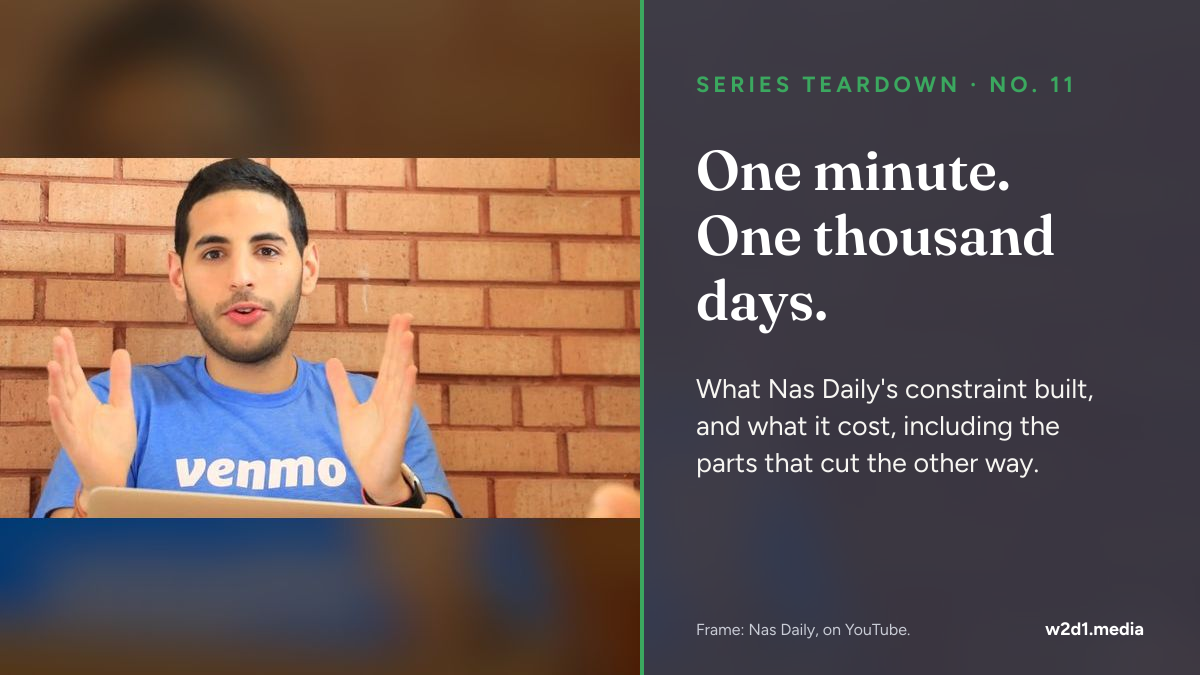
One video. One minute. Every day for 1,000 days, with a finish line announced on day one. Nuseir Yassin quit a US$120,000 job to do it, failed for the first 270 days, and ended with 11 million followers and a company that has since raised about US$50 million. Here is what the constraint did, and the parts of the story that cut the other way.
Series Teardown is a column about content series that are unusual in format and have the evidence to show they work. One series per instalment: how it started, the mechanics underneath it, the production reality nobody posts about, and what you can take from it for your own show. This one is the purest constraint-driven format in the column, and the one where I have to be most careful about what the creator says versus what anyone else can confirm.
The premise
Day one was 9 April 2016. The YouTube description read: "1 Video. 1 Minute. 1 Day. No more, no less." Every day after that, Nuseir Yassin posted a one-minute video from wherever he was, wearing a t-shirt with a battery bar showing how much of his life he had used, and ended it with "That's one minute. See you tomorrow!" Video 1,000 went up from Malta on 5 January 2019, per Mothership. He dropped the sign-off on that one.
The constraint is the entire format. There is no recurring segment, no guest, no set. There is a length, a cadence and a finish line, all declared in advance. Watch day one on YouTube: it is 60 seconds and it looks like nothing.
How it started
Yassin grew up in Arraba, in Israel's Arab community, took a scholarship to Harvard, and was a software developer at Venmo on a US$120,000 salary when, per Reuters in 2017, he worked out he had lived 32 percent of his life. "Oh, my God, I'm one-third dead," is how he put it to WBUR. He quit with US$60,000 saved, per Mothership, planning 60 videos, and chose Facebook over YouTube because, he told WBUR, "YouTube will die."
The number 1,000 was, in his words to a foundation podcast, "a number that made sense." One minute was what he could make in a day. The budget was US$100 a day against the US$3,500 a month he had been paying in New York, per Reuters.
Then it did not work. The first 300 videos "failed," he told WBUR, and the breakout came around day 270. From there the Facebook page grew the way press reported it at the time: 500,000 likes in March 2017 per Reuters, more than 4 million by January 2018 per WBUR, more than 8 million by September 2018 per the South China Morning Post, 10.1 million at day 938 per the Times of Israel, and around 11 million when the run ended in January 2019 per Mothership. His own later bios say 12 or 13 million at the finish. I am using the press figures. Calcalist reported about 2.5 billion views and a team of six in November 2018. Mark Zuckerberg met him in early 2018 and the page was given show status on Facebook, per Wikipedia.
What came after the 1,000 days is the business. Nas Academy and Nas Studios in 2020, Nas.io in 2023, a signing with Studio71 in November 2021 claiming 20 million Facebook followers and 300 million monthly viewers. Nas Academy raised US$11 million from Lightspeed in July 2021 and US$12 million more in July 2022. In April 2026 Nas.com announced a US$27 million Series A led by Khosla Ventures, claiming 3.5 million members and a five-fold revenue increase in 2025. Those last figures are the company's own. The New York Times put the staff at about 120 in 2022.
Why it works
Here is what I think is doing the work.
The constraint is public, so quitting is public. Most creators who say "I will post every day" say it to themselves. Yassin put the number on the screen: day 412 of 1,000. That turns every video into a progress bar, gives the audience a reason to come back tomorrow, and makes stopping a visible failure rather than a private one. The countdown is also the story. Nobody tunes in to a vlog to see what happens. Everyone tunes in to see whether he makes it.
One minute forces one idea. A daily format with no length limit degrades into a diary. Sixty seconds means every video has to have a point, a reason it exists, and a cut every few seconds. He has described the work as hours of thinking for a minute of output. The length constraint is really an editorial constraint, and it is why the videos travelled: a minute with a point is the most shareable unit on a feed that was, in 2016, built for exactly that.
The finish line was the marketing. A thousand days is a story with an ending, and endings get covered. Reuters came at day 328, WBUR at day 650 or so, the Times of Israel at day 938, Mothership at 1,000. A show that just goes on has no news in it. A show with a declared end has a milestone every hundred days.
It compounded for 270 days before it worked. This is the part most people copying the idea cannot stand. Nine months of daily videos that, by his own account, failed. The format held because the constraint did not allow for a judgement about whether it was working. He was not posting because it was working. He was posting because it was day 212.
The format produced the company, not the other way round. Six people at the end of the run became a studio, an academy and a community product with venture backing. The thousand videos were the proof of work that investors and clients bought: a demonstrated ability to produce a unit of attention every single day. The company sells that ability to other people now.
What it costs to make
The production cost is the obvious one: Calcalist reported about ten hours a day per minute of video, every day, for 1,000 days, with video 350 made from a hospital bed in Myanmar. That is roughly 10,000 hours of work for 1,000 minutes of output, which is a ratio no normal production would accept. The constraint only works if you are the production.
The second cost is the one that this column exists to say out loud. Almost every number about Nas Daily after 2019 comes from Nas Daily. Revenue has never been audited or published. The follower totals at the finish line differ by two million depending on who is counting. The 30 billion views and 70 million followers in the April 2026 press release are the company's claims. I have used the press figures where they exist and labelled the rest.
The third cost is reputation, and it is real. In August 2021 Nas Academy sold a course attributed to Whang-Od, the Filipino tattoo artist, for a reported 750 pesos; her grandniece called it a scam, the course was pulled, and the Philippines' commission on indigenous peoples found she had not signed the contract and described it as "grossly onerous," per Rappler, which Nas Academy denied. PhilStar reported the page lost about 600,000 followers in four days. The same month a Filipino creator alleged he had mocked her accent, and a regional human rights office opened an inquiry. Separately, his positions on Israel and Palestine, as a Palestinian citizen of Israel who declared himself "Israeli first" in October 2023, have drawn a boycott call in 2020, a disrupted event in Tokyo in 2024, and a backlash in December 2025 over an interview in which he called genocide "a very emotional, non-scientific word." A format that is entirely one person inherits everything that person does and says. The constraint made the brand. It also made it impossible to separate from him.
What to steal
Declare the constraint, the cadence and the end on day one. A number on the screen does what no amount of discipline can: it makes stopping visible. If you are launching a show, say how many episodes it is, and count them.
Make the length force the idea. Pick a unit short enough that every episode must have a point. The length limit is really an editorial limit, and it is why things travel.
Budget for the dead months. Nine months of daily output before anything worked. Decide now how long you will keep going without a signal, and make it longer than feels reasonable.
Treat the run as proof of work. A thousand of anything, made on schedule, is a demonstration that investors, sponsors and clients will pay for. The show is the portfolio.
Know that a one-person format inherits the person. Everything Yassin says now attaches to the brand, and the brand has paid for it in followers. If your format is you, there is no separating the two later. Decide whether that is the deal you want.