
There’s a good chance an Australian podcast statistic is going into a deck you’re building this quarter. There’s also a good chance it’s off by five points.
For a sponsor, a board, a client. And the version doing the rounds hides the most useful finding in the release.
I went looking for the primary source last week after seeing the figure quoted in the trade press. The number checks out. The sentence around it doesn’t.
What Infinite Dial 2026 actually found
Edison Research runs Infinite Dial Australia for Commercial Radio and Audio. The 2026 edition is the tenth. They surveyed 1,600 Australians aged 10 and over, in the field from 12 to 28 April.
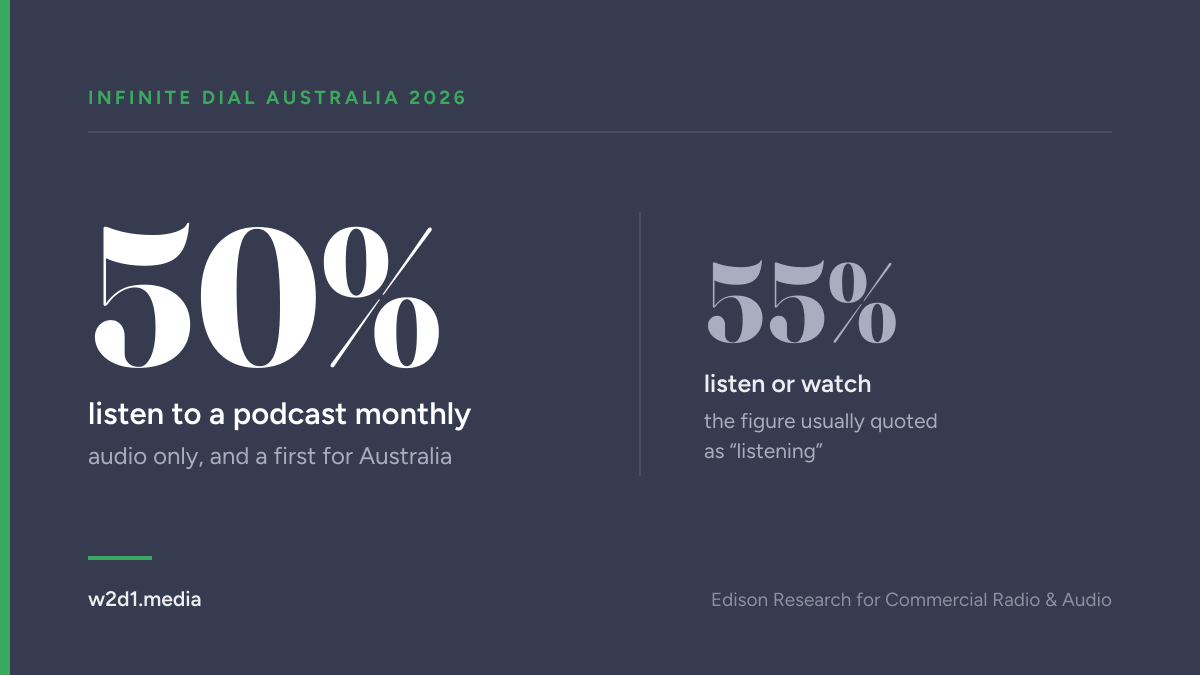
Audio-only podcast listening reached 50% monthly. First time it has touched half the population. That’s roughly 12 million people. Weekly listening sits at 45%, which is level with the US.
Include video podcasts and monthly consumption goes to 55%, up from 52% the year before. Forty per cent of Australians watched a podcast in the past month.
Of the people watching, 89% are doing it on YouTube. Spotify is 47%, Netflix 37%, Apple Podcasts 27%.
50 and 55 are two different arguments
The version circulating is “55% of Australians listen to podcasts monthly.” That attaches a listening verb to a figure that counts watching.
It’s five points. It also happens to be the interesting five points.
Reserve “listen” for 50, use “consume” or “listen to or watch” for 55, and the two numbers start doing separate work. One tells you the audio audience finally crossed half the country. The other tells you how many people are turning up to podcasts through a screen instead — and that nearly nine in ten of them are on YouTube.
Collapse them into one stat and you lose the only finding in the release that should change what you actually make. Audio-first with a video afterthought is a different product to one built for a YouTube-shaped audience, and the data has an opinion about which way that’s moving.
The line I couldn’t stand up
The same piece said monthly listening was “up from just 18% in 2018.”
I couldn’t verify it. Not from Edison Research, not from Commercial Radio and Audio, not from anyone reporting on the release. There may well be a real 2018 number behind it, but I couldn’t find one.
There’s a second problem underneath that. The 2026 study surveys Australians aged 10 and over. Earlier Australian editions used 12 and over. A comparison drawn straight across that change isn’t like-for-like, so even a correct 2018 figure wouldn’t give you a clean line from there to here.
If you want growth, the verified moves are sitting right there. 52% to 55% year on year. Or audio-only listening passing 50% for the first time, which is a milestone and doesn’t require anyone to take your word for the baseline.
Podcasting stopped being a young person’s medium
Buried under the headline figure: 35 to 54 year olds are now the strongest cohort, at 68% monthly. The 12 to 34s are at 64%.
That’s worth sitting with if you sell to founders, operators or investors. The demographic most people still picture as the podcast audience has been overtaken by the demographic most B2B companies are actually trying to reach. Same medium, different argument.
It also kills off the “podcasts are for reaching a younger audience” line that still turns up in media plans.
What this changes
Mostly, it changes what you should stop saying.
The category argument is finished. Half the country listens every month, weekly consumption matches the US, and the strongest cohort is middle-aged professionals. Nobody needs convincing the audience exists. So a sponsor deck that opens with market size is answering a question the buyer stopped asking about three years ago.
What they’re asking now is narrower. Who exactly is in your audience, how concentrated are they, and can you prove it. Those are harder questions and market data won’t answer any of them for you.
The other thing it changes is where you get your numbers. The piece that sent me down this road was a vendor column — a platform executive making a reasonable argument that Australian brands under-use the medium his company sells. The argument is fine. The statistic was misworded and one supporting claim didn’t hold up.
That’s normal. Industry commentary tells you what to go and check. It doesn’t settle anything on its own.
Half of Australia is listening. That part is true, it’s verified, and it’s the least interesting sentence in the report.
Figures from The Infinite Dial 2026 Australia, Edison Research for Commercial Radio and Audio. Fieldwork 12 to 28 April 2026, n=1,600 Australians aged 10+.