
What B2B podcast production involves for an Australian startup, when it is worth doing, how to measure it, and what it costs — from $2,450 +GST a month.
Most B2B podcasts started by Australian startups stop before episode ten. Rarely because the show was bad. Almost always because nobody owned the twenty small jobs that sit around the recording.
B2B podcast production is the work of owning those jobs — strategy, production, content and distribution — on a cadence the company can actually sustain. Here is what that involves, when it is worth doing, how to tell if it is working, and what it costs.
What B2B podcast production actually covers
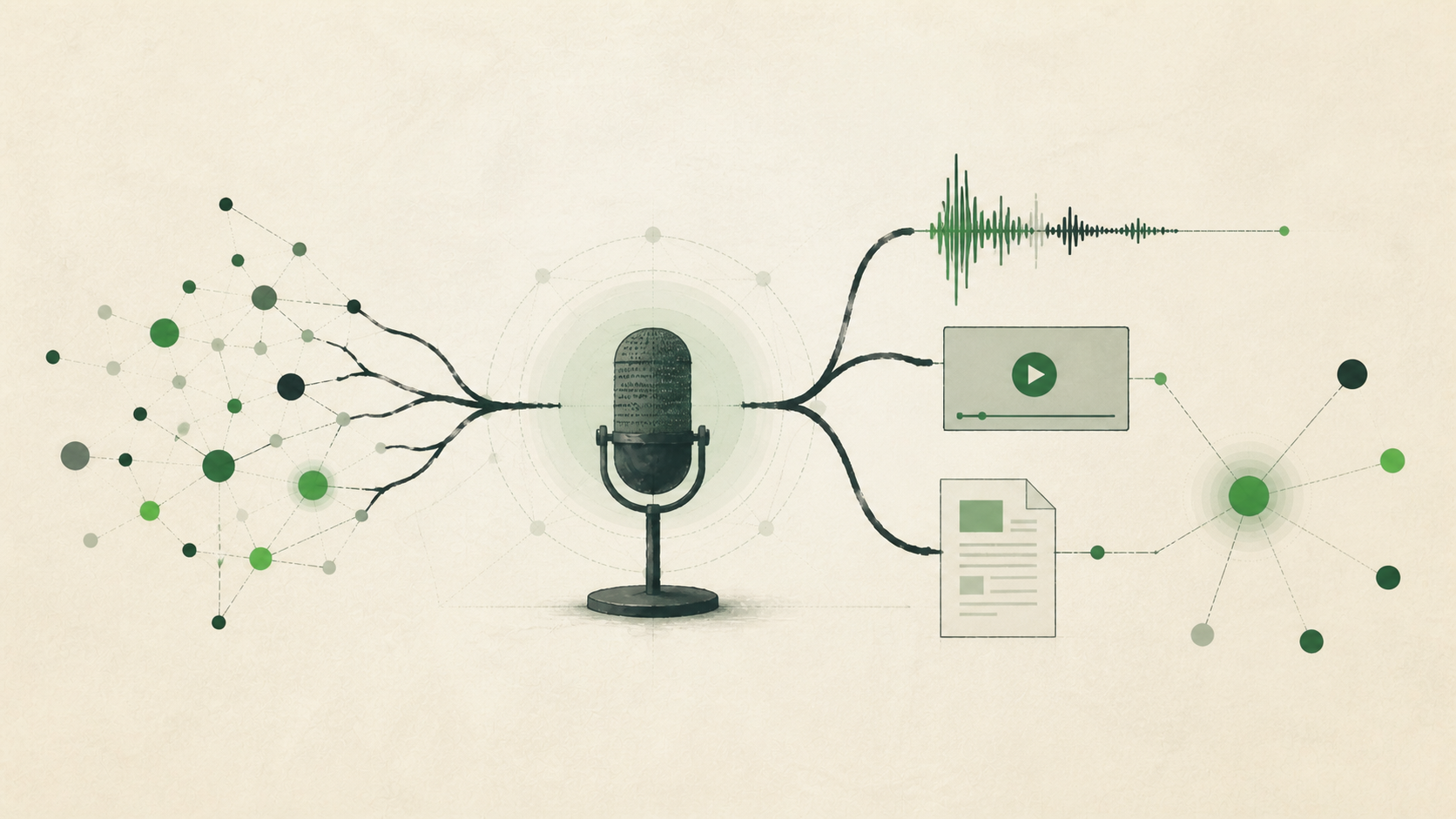
Four workstreams. A show fails when one of them has no owner, and the one most often left unowned is the last.
Strategy
Who the show is for, what it argues, the format, the guest engine, and the first block of episodes mapped before anyone records. This is the part that decides whether the other three are worth paying for.
Production
Guest booking and scheduling, recording support, the edit, and quality control on a fixed cadence. The deliverable is not an episode. It is an episode every fortnight, in a quarter when three other things went wrong.
Content
The recording is raw material. Clips, audiograms, show notes, thumbnails and quote graphics are what get the thinking in front of people who will never subscribe to anything.
Distribution
YouTube-first publishing, the podcast directories, LinkedIn, and a newsletter. Publishing is not distribution. An episode that goes live and gets shared once has been published and not distributed.
Why B2B is a different job from consumer podcasting
Most podcasting advice is written for shows that make money from audience size. A B2B startup show does not, and following that advice is how founders end up optimising the wrong number.
- Audience size is close to irrelevant. Two hundred listeners who are all your buyers beats twenty thousand who are not. Download totals flatter shows that will never produce a deal.
- The guest list is the strategy. For a B2B startup, who you invite is a pipeline decision before it is an editorial one. A show is a legitimate reason to have a long conversation with someone who would not take a sales call.
- It compounds, slowly. B2B sales cycles are long, and so is this. The show is a trust asset. It does not behave like paid acquisition and should not be judged on that timeline.
- The unit of value is a conversation, not a play. One episode that puts you in a room with the right operator can outperform a quarter of content that nobody acted on.
Designing for that deliberately is a different exercise from making a good show. We pulled the two apart in pipeline podcasts vs brand podcasts.
What is specific about doing this in Australia
Four things change the maths here, and they mostly work in a local startup's favour.
- The ecosystem is small and densely networked. A founder you interview is usually one or two introductions from your next customer. In a larger market that link is far weaker.
- Your total addressable audience is reachable. If you sell to Australian CFOs or heads of engineering, that is a countable group. A niche show can plausibly reach a real share of it — an ambition that is not available to a US startup.
- Timezones cost you a day per loop. Producing with an offshore team means every revision, every approval and every fix lands overnight. Over a fortnightly cadence that is the difference between shipping on Tuesday and shipping whenever.
- Local context is credibility. Guests, references and the shorthand of the market land differently when the show is made by people inside it. We have been producing founder-led shows for Australian tech since 2018.
When a podcast is the wrong move
This is a real question and the honest answer is sometimes no. Four signals that the money should go somewhere else for now:
- You cannot name the listener. Pre-product-market-fit, before you know who you sell to, a show becomes an expensive way to think out loud.
- Nobody internally will commit the hour. If the founder or a senior operator will not protect recording time in the calendar, no production partner can fix that. It is the one input we cannot supply.
- You need pipeline this quarter. A show compounds over quarters. If the number is due in six weeks, this is the wrong instrument.
- You want a volume play. If the plan is reach for its own sake, a podcast is an inefficient way to buy it.
If two of those are true, wait. Coming back in two quarters with a clear listener and a committed host is cheaper than launching now and stopping at episode eight.
How to tell whether it is working
Pick the measures before you launch, because the flattering ones are the easiest to reach for later.
- Guests who become customers, investors, partners or hires. The most direct return, and the easiest to trace. Track it from episode one.
- Accounts that reference the show unprompted. When a prospect mentions an episode on a call, the show has done the job that content is supposed to do.
- Retention inside episodes, not download totals. Where people stop tells you what to change. Totals tell you nothing you can act on.
- Search and YouTube surface area over six to twelve months. Episodes are durable assets. They should be accumulating impressions long after the week they went out.
The structural decisions that move the third one are made in the edit — we derived ours from a full-season retention analysis, written up in the retention-optimised episode structure framework.
What it costs
We publish our prices so you can work out whether we are in range before booking anything.
- Fortnightly — $2,450 +GST a month. Two fully produced episodes, up to 45 minutes each. Full edit, a trailer and a vertical promo clip per episode, show notes, description, metadata and thumbnail, published to your feed and the Day One® Network channels, one round of reputational revisions, and a dedicated account manager. Month to month, no lock-in.
- Weekly — $4,900 +GST a month. Four episodes. Everything above, doubled, with a priority production slot.
- Setup — a one-off $2,000. Applies when you bring a show that is already defined. Waived if you develop the show with us first.
- Show development — around $18,600 +GST. The 14-step framework that designs the show before anyone records. A separate engagement, and it can be split across twelve months.
Studio recording, episodes past 45 minutes, extra revision rounds and episodes beyond your tier sit outside the retainer. The full breakdown is on the production packages page, and we pulled the cost question apart properly in how much it costs to produce a podcast.
Every show we produce also plugs into the Day One® Network — cross-promotion across the other shows, a slot in the founder newsletter, and an audience of Australian founders, operators and investors who are already listening. Your show does not launch into a vacuum.
Common questions
How long before a startup podcast produces pipeline?
Guest-driven outcomes can land in the first month, because the invitation itself opens the conversation. The compounding effects — inbound, search, being the show people already know — run on a longer clock. Budget for four quarters and judge it on conversations, not downloads.
How often should we publish?
Fortnightly, for almost every startup. It is sustainable through a raise, a launch and a bad quarter, and a consistent fortnightly show beats a weekly one that stops in March. Move to weekly once the format is proven and the guest pipeline is full.
Should the founder host it?
Usually yes, early on. The founder can get guests nobody else can, and in B2B the audience is buying the thinking behind the company. The risk is the calendar. If the founder cannot protect an hour a fortnight, choose a different host before you launch, not after episode six.
Do we need video?
If you want the clips, yes — they are cut from the video edit. Audio-only is cheaper and fine if your listeners live in podcast apps, but most B2B distribution now happens on YouTube and LinkedIn. Decide before you record.
We already have a show and it has stalled. Can you take it over?
Yes. That is what the one-off $2,000 setup fee covers — we take on an existing show, learn its format and pick up the production loop. If the stall is structural rather than operational, developing the format properly is the better fix.
Can we just run it in-house?
You can, and it is the cheapest option on paper. It is the most expensive in attention, and it is the first thing dropped when a raise or a launch lands — which tends to be exactly when the show is starting to compound. If the edit specifically is your bottleneck, podcast editing is the narrower version of this question.
Where to start
If you know who the show is for and who is hosting it, you need a producer and a cadence. If those two answers are not clear yet, start there — it is much the cheaper mistake to fix, and it is the whole point of the 14-step development framework.
Thirty minutes on a call will tell you which of the two you are, and whether the answer is not yet. No deck, no pitch.