
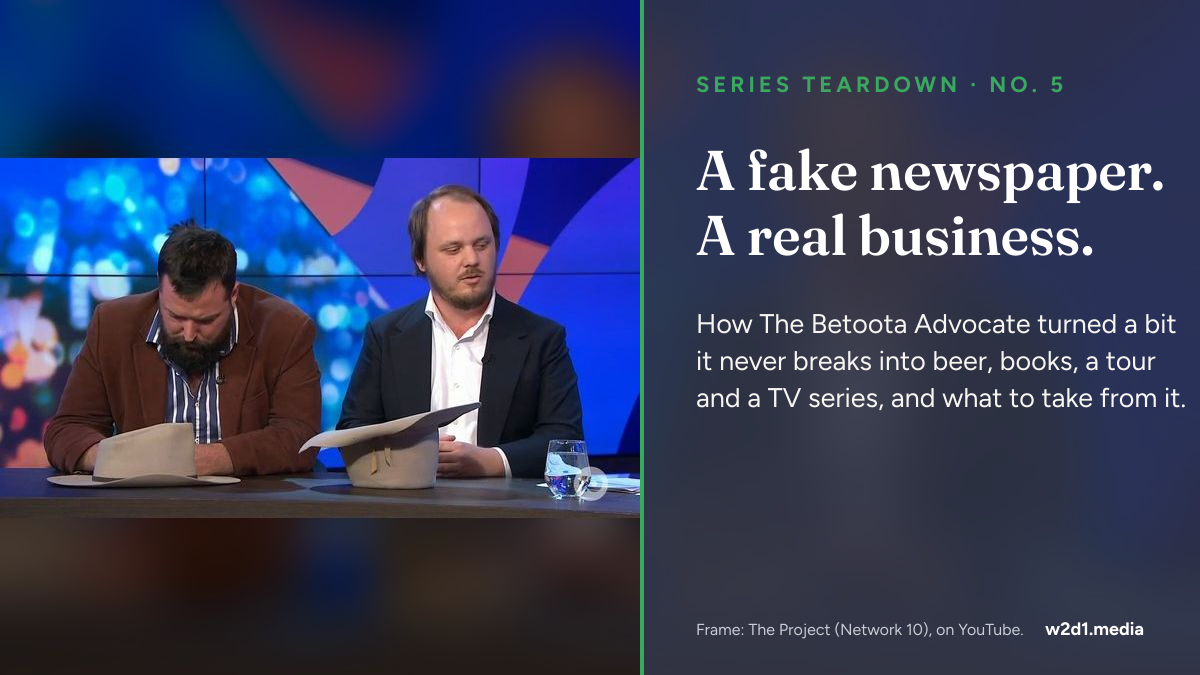
Two blokes in character as editors of "Australia's oldest newspaper", filed from a town in far-west Queensland that has no residents. Twelve years on it is a beer, a book deal, a national tour, a podcast with prime ministers on it and a Paramount+ series. Here is how the bit became a business, and what nobody outside it actually knows.
Series Teardown is a column about content series that are unusual in format and have the evidence to show they work. One series per instalment: how it started, the mechanics underneath it, the production reality nobody posts about, and what you can take from it for your own show. This one is the first Australian subject, and the first where the people who run it have never once stepped out of character to tell you how it works.
The premise
The Betoota Advocate is a satirical news site that presents itself as the digital edition of a regional newspaper from the Channel Country of far-west Queensland. Its about page calls it "Australia's oldest newspaper", established in the mid-1800s, which it then hedges as "arguably". Betoota is a real place and a deserted one. The editors are Clancy Overell, a "homegrown Betootan", and Errol Parker, editor-at-large and supposedly a former deputy editor of the News of the World. Wikipedia records that they are the pen names of journalists Archer Hamilton and Charles Single, and that the pair stay in character in nearly all public appearances.
The site publishes short, fast news stories about Australian life as that newspaper would see it: a parking ranger who booked himself, a man fighting off a home invasion at 78, a politician's week. Some of it is about the Prime Minister. Most of it is about you. To see the editors in character, watch their interview on The Project, on YouTube, four and a half minutes.
How it started
Wikipedia's account, drawing on early press, is that Hamilton had planned a conservative newspaper for his hometown of Mitchell, Queensland, and that the idea turned satirical as he focused on the oddities of country-town life. He and Single met publisher Piers Grove, who had produced the ABC's satirical show The Roast, and the website launched in 2014 from inner Sydney, beside a PR consultancy. In their own version, told to Mediaweek in 2018 and never broken, the two met at a Central Queensland race meet in 2014 and a cadet intern suggested putting the paper on social media.
The first evidence it worked was people being fooled. In November 2014 the Weekend Today show reported the parking ranger story as fact. In January 2015 Deadspin ran a Betoota story that the 2016 Olympics would include three-on-three basketball before realising the source. In March 2015 radio station 4BC did the same with the home-invasion story. By December 2016 a Hitwise analyst writing for Mumbrella reported that in six months the site had passed the Australian traffic of both The Onion and The Shovel, with a readership skewed male and heavily 18 to 34. Facebook did the distribution: Mediaweek put the page above 500,000 likes by August 2018.
Then the newspaper started selling what newspapers sell. A book of the year's stories in October 2016 and more since, including How Good's Australia in 2019. Betoota Bitter, brewed with Sydney's Yulli's Brews, from January 2017. A national live tour with TEG Dainty in late 2018 that finished at the Sydney Opera House. Betoota Talks, a podcast that Apple Podcasts now lists at more than 800 episodes and that SmartCompany says has had Anthony Albanese and Malcolm Turnbull on it. A 2021 deal with Warner Bros. International Television Production that became The Betoota Advocate Presents, four satirical documentaries on Paramount+ from June 2023 covering Hillsong, the Super League war, Fine Cotton and the Cronulla riots. And in September 2025 a LinkedIn post claiming a takeover offer from News Corp, which turned out to be a joke, and which drew a half-serious counter-offer from the co-founder of Tanda and an admission from Parker that real bids had been "many and varied".
Why it works
Here is what I think is doing the work.
The bit never breaks. This is the whole thing. Twelve years in, there is no behind-the-scenes interview, no founder's story, no "the real me". The masthead has a fictional history, the editors have fictional CVs, and when the ABC asked about staff numbers in 2019 Parker said "about 240 writers" and complained about payroll tax. Every other media brand eventually explains itself and loses something. Betoota's refusal to explain is the asset, and it is why a nine-year-old gag about being Australia's oldest newspaper still lands. Parker's one honest line, to the ABC: "As long as the person staring back at you in the mirror is a joke, it makes it easier."
It is specific to a place that only Australians can read. The Onion satirises a generic American town. Betoota satirises a specific one, from a specific angle, with references nobody outside the country would get: Tarocash, the VB longneck, the Channel Country. That is why the Hitwise numbers put it above The Onion here and nowhere else, and why it will never go global. Specificity bought the audience. The ceiling is the price.
The format already had a business model. A fake newspaper can sell everything a real newspaper sells: ads, sponsored editorial, a subscription, merchandise, a book of the year, a live tour. Crikey reported in 2019 that a brand could have itself satirised for A$8,500 an article, which the editors called "bread and butter brand integration" and said was less than one percent of output. The beer and the tour are not merch bolted onto a content brand. They are what a country paper would do. The format chose the revenue lines.
Speed is the craft. Most of the content, the editors told the ABC, is workshopped on the day it runs. Overell's line was that "you didn't have the 25-minute turnaround during children overboard." A satirical newspaper that reacts within the hour is competing with the news itself for the same scroll, and it usually wins the share.
They decided who they would not take money from. Overell told the ABC the rule is to avoid any industry facing a royal commission or likely to, and that this had meant saying no to "a lot of banks and betting agencies." For a brand whose only asset is that its audience believes it is not for sale, that rule is the moat.
What it costs to make
Here is where this instalment differs from the others, and I would rather say it plainly than pad it. The Betoota Advocate does not publish its numbers, and almost nothing about it has been independently measured.
Its own advertising page claims more than 4 million readers a month, 753,000 social followers and 180,000 podcast listens a month. Those are the publisher's figures with no method behind them. A third-party counter puts Instagram near 1.26 million followers; a snapshot of the Facebook page shows about 889,000. The only independent audience data I can find is the 2016 Hitwise comparison, and that is a ranking, not a count. Revenue, staff, ownership structure beyond a holding company name, the terms of the Paramount+ deal: none of it is public. The one price on record is the A$8,500 sponsored article, from 2019.
So the visible costs are the ones you can infer. A near-daily publishing rhythm for twelve years, reacting to the news on the day, from a team whose size is itself a running joke. A 2019 Crikey investigation into undisclosed sponsored content that the editors answered by saying it was a trickle and that readers would need to dig through thousands of posts to find it. An RSPCA complaint in 2014 over a story with invented quotes and no satire label. And the discipline of never telling anyone how it works, which is a cost as much as an asset: nobody can verify the business, so nobody can value it, which may be exactly how the editors like it.
What to steal
Commit to the bit all the way. A persona that only holds on camera is a costume. Betoota's holds in interviews, in books, on stage at the Opera House and on LinkedIn. If your show has a conceit, decide now that you will never step outside it to explain, and then do not.
Be specific to somewhere. The references that lose you the global audience are the references that win you the local one. For an Australian founder show that means the local investor names, the local tax rule, the local failure. Nobody in Ohio needs to get it.
Pick a format that already has a business model. Betoota did not have to invent revenue lines because the newspaper form came with them. Ask what your format's real-world equivalent sells, and sell that.
Write the no list before anyone calls. Betoota's rule on banks and betting was set before the money arrived. Decide which sponsors your show will refuse while it is still cheap to refuse them.
Know what the secrecy costs. Betoota's refusal to publish numbers protects the joke and makes the business unknowable, which is fine if you never want to sell it or raise against it. If you do, the audited number is the asset. Publish yours.