
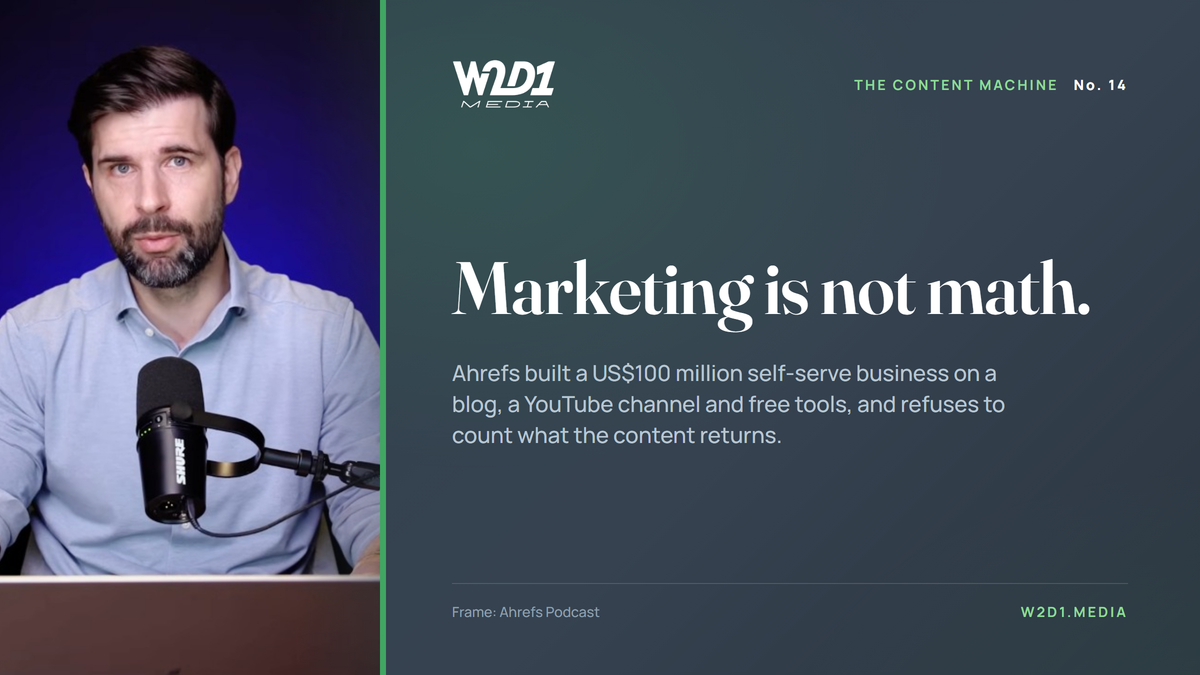
Ahrefs sells SEO software, and it markets it by teaching SEO in public: more than a thousand blog posts, a YouTube channel publishing about twice a week, free courses, a podcast, a conference and free tools that the CMO calls lead generation. The founder said in 2019 the company had no sales team; the CMO said in 2025 it does more than US$100 million a year in revenue nobody touches. The same CMO says the return on the content cannot be calculated, so Ahrefs does not try. Here is the machine, and the argument about counting it.
The Content Machine is a column about startups and scaleups that run content as a system: what they make, how often, how it is reused, where it goes, who makes it, how it is measured and what it moves for the business. Ahrefs is here because it is the purest example I have found of a company whose marketing is its content and nothing else, and because the person who runs it has spent five years arguing, in public, that the content's return cannot be measured and should not be. Every figure is attributed to the person or document it came from, and the company's own numbers are labelled as the company's.
The premise
Ahrefs sells search engine optimisation software: a crawler of the web and the tools on top of it for keywords, backlinks, site audits and, lately, visibility in AI answers. Dmytro Gerasymenko founded it, bootstrapped it from about US$300,000 of personal money according to its CMO, and the company's own about page puts its headquarters in Singapore. It has taken no outside investment. Gerasymenko told the Ukrainian outlet AIN in May 2019 that he had "rejected all investment offers, preferring to focus on product development."
The machine, in one paragraph. A blog of 1,046 posts, by my count of its own feed on 16 October 2026, in which every article is written to show the product solving the reader's problem. A YouTube channel that in 2020 published one video a week and now publishes about two. Nine free courses in an academy, a podcast hosted by the CMO, a conference called Evolve that ran in Singapore and San Diego this year, a weekly newsletter the company says is read by 284,000 people, and a free tier of the product that the CMO describes as lead generation. The people who make it pick their own topics from a keyword list scored for how easily the product can be pitched. The one piece to look at is a data study published this month, fifteen million queries analysed in the company's own tool, which is what the machine makes when it is working.
How it started
Tim Soulo joined Ahrefs in 2015 as, by his own site's count, employee number sixteen and the only marketer. The product already sold itself to the people who knew what it was. Gerasymenko put it this way in 2019: "We managed to create a product that promoted itself at an early stage." The first customers had come from "placing ads on SEO forums", and after that from word of mouth.
What Soulo added was teaching. The blog had existed; he rebuilt it around the people who buy SEO software and what they search for, and in 2018 he told the Marketing Strategies podcast the operating rule was simple: "we simply try our best to create the best freaking article on the topic." That year, by his own account on the same show, the whole company was 45 people and the marketing department "10 or 12". Gerasymenko said in 2019 that the company had "crossed $40M ARR" in 2018 and that "We have no sales team to this day."
The video side came next. By 2020, Sam Oh, now the company's vice president of marketing, had the YouTube channel on a weekly rhythm, and wrote the schedule down: "we publish one video per week", on Wednesdays, with an in-app notification to customers within hours and, on Thursday, "an email to our blog subscribers with a link to our newest blog post and video." A post and a video, paired, every week. That pairing is the spine the rest of the machine grew on.
How the machine works
Every topic is scored before it is written. Ahrefs' own 2022 account of its content strategy, by Si Quan Ong, says the team writes about "topics with business potential, search traffic potential, and ranking potential". Business potential is "how easy it will be to pitch your product" in an article on that keyword. Traffic potential is "the estimated monthly organic search traffic to the top-ranking page for a keyword." Ranking potential means "it's viable for us to rank in the top three with our available resources." Soulo told the Long Game podcast in 2021 that "90% of our content strategy is based on keywords" and that "Our team members pick their own topics." The list is the editorial calendar.
The product is in every piece. The company's own definition, from the same writer in May 2022: "Product-led content is content that helps the reader solve their problems using your product." And: "This is not a hard sell." Soulo's version, from the 2021 podcast, is more candid: "we want people to start using our product in their heads". In 2024 he put it in four words to Nathan Latka: "All of our content incorporates our product."
The cadence has fallen by half, by my count. The blog's own feed gives 37 posts in 2019, 163 in 2022, 216 in 2023, 185 in 2024, 174 in 2025, and 105 in 2026 to 16 October, with 22 in the last three months. That is about four a week at the 2023 peak and under two a week now. The video channel went the other way: the 2020 schedule was one a week, and the channel's feed shows fifteen uploads in the seven weeks to 12 October 2026. The podcast, which Soulo started in 2024, took "3 months, 10 episodes, and a TON of promotion" to reach what he called "a measly 10,000 downloads", and each interview runs about two hours. He also wrote down who does the rest: a community manager who researches guests and edits, two people on intros, one on thumbnails, one on uploads, because "the actual interview is maybe 40% of work."
Old content is maintained on a schedule. In 2022 the rule was quarterly: "We don't just publish our content and forget about it." Every writer reviewed their own posts each quarter and took the list to the head of content. By June 2026 the data posts had an agent: fourteen data-driven articles sit in a refresh hub, and "Once a month it pulls fresh data for all 14 datasets", drafting the update for a human to check and publish. The writer who built it says it saves "at least 20 hours per month" and that before it, "we refreshed them every quarter."
Distribution is Google, YouTube and the inbox, with paid money spent carefully and counted badly. Soulo told the SaaS Club podcast around 2019 that "we only care about traffic from Google", and that when sign-ups are asked where they heard of Ahrefs, "the vast majority of people say that" they found it through Google or the blog. The Thursday email and the weekly digest carry each piece to subscribers. Ahrefs also buys podcast sponsorships and wrote up the results in 2018: US$14,200 across five shows produced 339 page views and eleven trial sign-ups, "almost $1.3k for each trial signup"; a second round of US$37,775 produced 126 paid trials. Soulo's verdict in the post: "It was quite foolish to expect a substantial ROI from 'cold advertising' a complex product like Ahrefs." The social layer, described by a colleague in 2025, is a Zapier flow that "waits for a new article on our blog, creates three types of LinkedIn posts and uploads them to Buffer for review."
Measurement is the argument, and the CMO has won it internally. In March 2021 Soulo listed ten ways content returns value to Ahrefs, from new customers to fewer support tickets, and then asked whether the total could be calculated. His answer: "Impossible." And: "That is why here at Ahrefs we don't even track how many leads we get from our articles organically". The company removed Google Analytics around the time of the European privacy rules, he told SaaS Club, and what it keeps is a question on sign-up, "where did you learn about Ahrefs?" In December 2025 the fourth of his five principles was "Marketing is not math." His own team is less absolute. Ryan Law, the director of content marketing, wrote in 2024 that "attribution is never perfect", and Louise Linehan wrote this month that "I don't think you can ever neatly prove AI search ROI", before explaining how the sign-up question is used to try.
What the record does not show: a share of sign-ups from the blog, a cost per customer, a marketing budget, or any engineering headcount to set the marketing team against.
What it moves for the business
The figures, with their owners. Gerasymenko, May 2019: past US$40 million in annual recurring revenue in 2018, about 45 people, no sales team. TechCrunch, June 2022, relaying the company's claim: US$100 million in annual revenue from more than 50,000 customers, and US$60 million of resources going into its own search engine, Yep. Soulo to Nathan Latka, March 2024: "we're over $100,000,000", "no VC funding, none of that", 125 people including the search engine staff, and "We didn't have a sales team till we hit about $100,000,000", with the first salesperson hired in 2021. Soulo again, December 2025: Ahrefs "does $100M+ in self-serve ("no touch") ARR", with about 100 employees by his count. The headcounts disagree with each other and with the about page's 149, so each carries its date.
The only sign-up attribution Ahrefs has published is about AI search, not content: Patrick Stox wrote in June 2025 that AI search "accounts for just 0.5% of our traffic" and yet "12.1% of signups from 0.5% of the traffic", with those visitors converting "at a 23x higher rate than traditional organic search visitors for Ahrefs." The figure comes from the company's own analytics tool.
Then the part the record only half shows. An attendee at Evolve Singapore in May 2026 reported Soulo saying that search traffic to ahrefs.com fell after Google's March 2025 core update and has kept falling as AI answers spread. That is a paraphrase in someone else's write-up, and Ahrefs has published no traffic figure of its own. What it has published is a change of subject: an academy course on answer engine optimisation, fourteen data studies in six months by Soulo's count in June, and a YouTube schedule that has doubled, while the blog that made the company has halved its output.
The limits are the point of this instalment. The claims come from the founder and the CMO, who have made them for seven years without once attaching a conversion rate. The refusal to count is a principle, stated in public with ten reasons, and it is also why this column cannot tell you what the content is worth. Ahrefs says the machine built a US$100 million self-serve business. Nothing on the record lets anyone check.
What to steal
Score the topic for the pitch before the traffic. Ahrefs writes down how easy the product is to pitch on a keyword before it looks at search volume. Put that column in your list and watch what drops out.
Pair the formats on a fixed day. A post on Wednesday, the video with it, the email on Thursday. The machine ran for years on that one rhythm before anything was automated.
Put a maintenance rule on the calendar, then automate the dull half. Quarterly self-review in 2022, a monthly data refresh agent in 2026. The order matters: the rule first, the tool when the rule is boring.
Decide what you will not measure, and say it out loud. Soulo's position is coherent because it is explicit. If you are going to run content without attribution, write down the ten reasons and the one question you will still ask at sign-up.
Watch the channel that made you. Ahrefs' blog output has halved since 2023 and its video output has doubled, in the same period its CMO says search traffic fell. When the company that sells SEO tools moves its own weight to YouTube and AI visibility, that is the most honest signal it has published.