In 2021 Cognism's marketing team generated 31,562 content leads and closed 46 deals from them, a rate the company itself puts at 0.14 percent. It then pulled the gates off its content, rebuilt the team around the people it was trying to reach, and moved the measure from leads to pipeline. Cognism says the LinkedIn side of that machine alone has since influenced nearly 2,000 won deals. Here is how it works, in Cognism's own numbers, with the ones that do not line up left in.
The Content Machine is a column about startups and scaleups that run content as a system: what they make, how often, how it is reused, where it goes, who makes it, how it is measured and what it moves for the business. The rule for getting in is that the company has said in public, with numbers, that the content moves revenue. Clay was first because it published the clearest account of a machine fitting together. Cognism is second because it published the clearest before and after. Every figure here is Cognism's own unless I say otherwise, and most of them come from a post on its blog by Amy Collins, first published in July 2024 and updated in March 2026, plus the two volumes of its former chief marketing officer's diary.
The premise
Cognism sells B2B sales intelligence: contact data and the tooling to prospect with it. It was founded in 2016 by James Isilay and Stjepan Buljat, per its investor PeakSpan's announcement of the seed round, raised a US$87.5 million Series C in January 2022 per the trade press, and its own blog in March 2026 described the company as on the way to US$100 million in annual recurring revenue.
The machine, in one paragraph. Cognism runs two content operations side by side. One is search content, planned about a quarter ahead, written by a small SEO team, measured on the people it brings to the site. The other is what the company calls demand creation: podcasts split by buyer persona, newsletters, big campaigns, live monthly webinars, and a LinkedIn programme that puts the company's own subject-matter experts in the feed, none of it gated behind a form. The measure for the second operation is consumption first and pipeline second, and the sales handover is a free-text box on the demo form that asks how you heard of them. The Collins post is the primary source and the one piece of Cognism content to read if you read one.
How it started
The person who built it is Alice de Courcy, who ran Cognism's marketing for roughly seven years according to the podcast listings that now describe her as its former CMO, and who wrote the operation up as it happened in a book called Diary of a First-Time CMO. The first volume sets the starting brief in her words: "I was asked to create a marketing function that brought in 50% of the revenue target." The team was three people when she started, per Cognism's own guide, and the focus was events. Her first three hires, per the diary, were a content marketer, a designer and a videographer, which tells you what she thought the function was before she could prove it.
The first machine was the one every B2B marketer built in the late 2010s. Gated ebooks promoted on LinkedIn, downloads counted as leads, leads passed to a team of market development reps who called them. It worked by its own measures. The diary records ebook downloads for about US$10 each on LinkedIn, "which was unheard of", leads that "would close at a rate of 12%", and a lead-to-sales-qualified-opportunity rate that went from 5 to 15 percent. It also records the cost: "1 MDR needed 400 MQLs a month" to hit number. The diary's headline for the period is "scale Cognism from $3m to $50m ARR, build a team from 3 to 39".
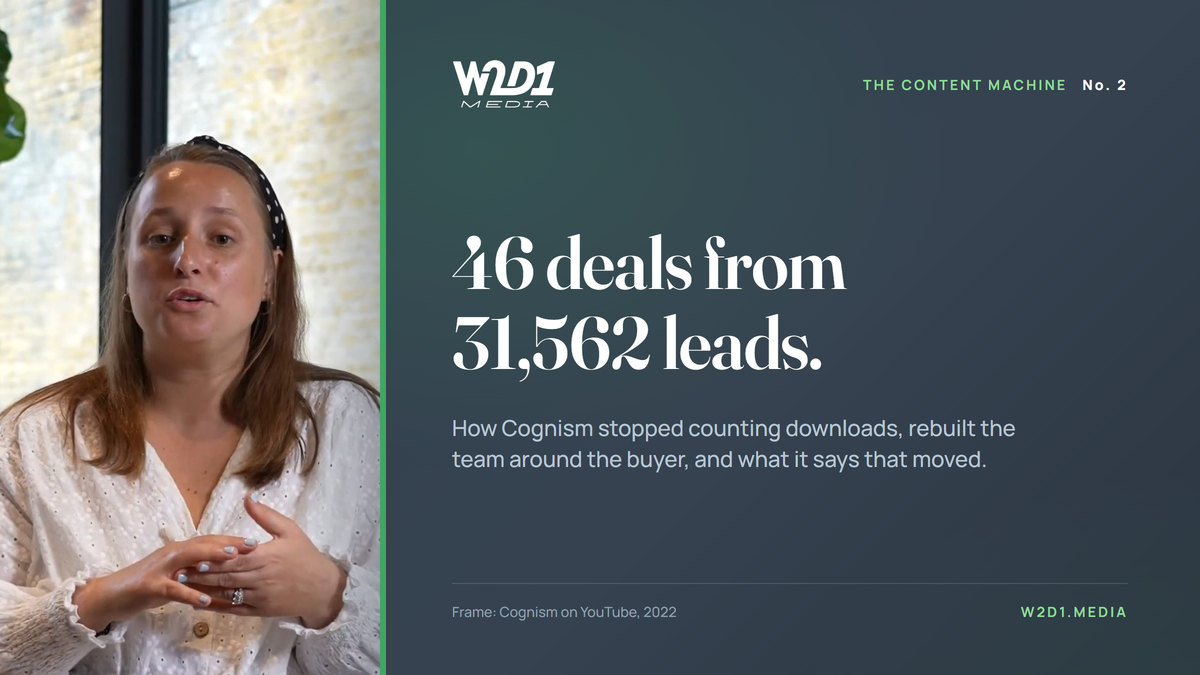
Then the company counted differently and got a different answer. The Collins post gives the 2021 figures: 31,562 content leads, 46 closed-won deals from them, "a conversion rate of 0.14%". Inbound, meaning people who came and asked for a demo, "made up 85% of our closed-won revenue, while content made up just 15%". I cannot reconcile the diary's 12 percent close rate with the post's 0.14 percent, and neither does Cognism; they are different years and almost certainly different definitions of a lead. What matters is which number the company chose to act on. From mid-2021, going by the dates on its own YouTube uploads, Cognism's marketers were on camera explaining a move from lead generation to demand generation, and by March 2022 they were explaining why the gates had come off.
How the machine works
Two pillars, run differently. De Courcy described the structure in an interview with the chatbot company Landbot: an SEO pillar planned about a quarter ahead, and a demand-creation pillar that is ad hoc and reacts to what the market is talking about. The Collins post names the roles that staff them: demand-generation content managers, SEO marketers, demand-generation managers who each own pipeline for a region, the subject-matter experts who front the content, and a market development role that works the inbound. The diary's version of the content team is two SEO specialists, two journalists, and demand-generation content executives in two pods, one for the sales persona and one for marketing. Pods by persona is the detail I would copy. The podcasts are split the same way.
The experts do the talking. Cognism's own people front the podcasts, the webinars and the LinkedIn posts. De Courcy told Landbot the company runs internal LinkedIn workshops and competitions to get its experts posting, and that one person on the team is dedicated solely to distribution, including Reddit. The programme the Collins post calls "LinkedIn create demand" is the one with the big number attached: it "has influenced nearly 2,000 won deals since June 23, with an opportunity win rate +44%". Two cautions on that sentence. "Influenced" is the company's word, and it means the deal touched the programme, not that the programme sourced it. And "June 23" has no year on the page. I read it as June 2023, but Cognism has not said so.
Nothing is gated, and the measure moved with it. The Collins post puts engagement first and leads and pipeline second. De Courcy told Landbot the main metric is consumption in the feed, that the team tracks the full funnel to closed-won, that early signs show at about month three and revenue at about six months, and that the demo form's thank-you page asks, in free text, "It would be really helpful for us to know how you heard of us". That question surfaced podcasts the attribution tools could not see. The honest footnote, also from the Landbot interview: the SMB segment still runs "70% on the ungated model and then 30% delivery of MQLs". The gates came off most of the house, not all of it.
The cadence is the part the record leaves thin. Cognism's pages name weekly podcasts and a monthly live webinar series, and the diary records that after the first webinar the chief executive and chief revenue officer asked for one every week. I could not find a published posting schedule for LinkedIn or the newsletters. The company is more forthcoming about results than rhythm, which is the opposite of most content teams.
Paid spend points at content, not forms. Distribution, per Landbot, is paid LinkedIn and Facebook, the podcasts and newsletters, events, SEO and the experts' own feeds. The Collins post says the demand programme returns "over 3x" its spend. That is a company figure with no method shown, so I report it as one.
What it moves for the business
Cognism's claims, labelled. Content leads converted at 0.14 percent in 2021 and the company changed the model. The LinkedIn demand programme has influenced nearly 2,000 won deals with a 44-point lift in opportunity win rate. One team reached 135 percent of its pipeline target and 120 percent of its revenue target; the post gives those figures, and my copy of it did not carry the region or the half-year they belong to, so I will not guess. Liam Bartholomew, then global head of demand generation, said on the Market Mentors podcast in June 2022 that inbound pipeline had grown four times over since the shift, with no timeframe in the show notes. And the diary's own arc, in its own words: US$3 million to US$50 million in ARR across the years it covers.
What makes me take the figures seriously is the one Cognism volunteered against itself. A company selling the demand-generation story, which Cognism now does, through a webinar series called Demandism and a partnership with the agency that popularised the term, had no commercial reason to publish that 31,562 leads produced 46 deals. It did anyway, and it published the 30 percent of SMB still on MQLs. None of this has been checked by anyone outside the company. The limit is the same as last time: the company does not say which part of the machine moved which deal, and I would not expect it to.
What to steal
Count deals, not downloads, for one quarter, before you decide anything. Cognism's model did not change because a consultant said gates were bad. It changed because someone divided 46 by 31,562. Run the division on your own content leads before you argue about forms.
Split the team by who it is talking to, not by what it makes. A pod for the sales buyer and a pod for the marketing buyer, each with its own podcast, outlasts a team split into writers, designers and video. The persona is the unit of work.
Put a free-text question on the demo form and read every answer. "How did you hear of us" in the customer's own words found the podcasts the tools could not. It costs nothing and it is the only attribution most companies will ever get for a show.
Give one person distribution as their whole job. Not the writer, not the host. Someone whose only measure is where the content went, including the places your ads cannot reach.
Keep the gate where it still pays. Cognism left 30 percent of SMB on the old model. Ungating is a decision per segment, not a religion.