Culture Amp's content machine is a community. A weekly newsletter for HR people, a conference called Culture First, and in one year 120 events across 23 cities, run by a company that sells employee-engagement software to the people in the room. Didier Elzinga has called it "a big part of our engine". The numbers are thinner than the story, the company has had a hard three years, and both of those things are in here.
The Content Machine is a column about startups and scaleups that run content as a system: what they make, how often, how it is reused, where it goes, who makes it, how it is measured and what it moves for the business. Culture Amp is the first Australian company in it, and the first whose machine is mostly rooms. The content is a newsletter, a conference and a very large number of small events, all aimed at one profession, and the company's founder has said on the record what he thinks it did. I have kept his words and labelled everything else.
The premise
Culture Amp sells employee-engagement and performance software, founded in Melbourne by Didier Elzinga and three co-founders and funded through a 2021 round that IT Brief reported at US$100 million and a US$1.5 billion valuation; other outlets gave different figures for the same round, so I am attributing that one and moving on. The company says its community of "people geeks", its name for HR and people-operations professionals, passed 50,000 in 2019 by Elzinga's count and 100,000 by its own 2024 claim.
The machine, in one paragraph. A weekly newsletter called People Geekly, which the company said had nearly 30,000 readers in 2022, compiled by one person. A conference, Culture First, launched in San Francisco in June 2018 with about a thousand people and more than 1,100 the next year, later run virtually with the company claiming more than 20,000 viewers in 2021 and more than 30,000 in 2024. Local meetups: Elzinga said that in one year "we did 120 events across 23 different cities." A Slack community a vendor's blog put at 43,000 members. A blog and research reports behind it all. The one piece to read is the People Geekly story, Culture Amp's own account of how the newsletter started.
How it started
The idea came before the marketing department. Elzinga's framing, in a long interview on the Growth Everywhere podcast recorded around the end of 2017, is that Culture Amp set out to serve a profession rather than to market a product to it: HR people who cared about data and culture, whom the company named people geeks and gave somewhere to meet. The meetups came first and were cheap; he put the cost of an event at "$50 to several thousand dollars", with the big ones "into the hundreds of thousands". The newsletter followed as the thing that held the community together between rooms. The conference, Culture First, came in 2018 once the meetups had shown there was a crowd.
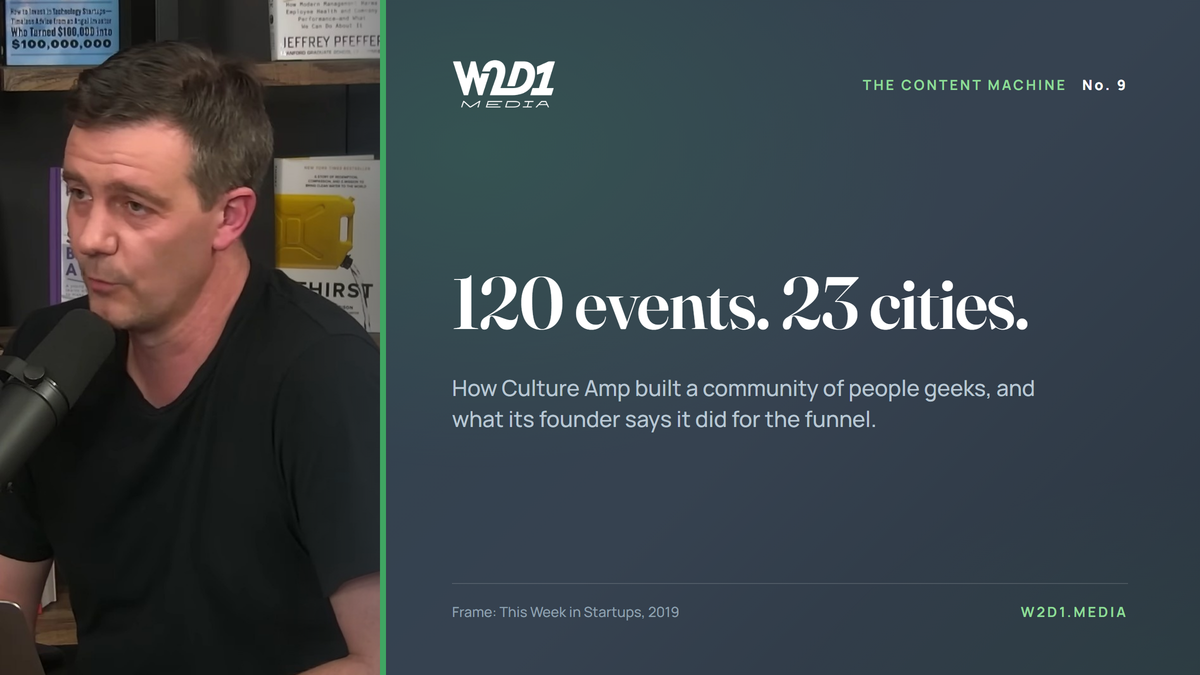
What he said it was for is the quote this instalment turns on. Events, he said, are "a really great way of bringing people into the funnel or into the community", and the community as a whole: "That's really been a big part of our engine." He did not give a number, and in the two hours of that conversation he was not asked for one.
How the machine works
One audience, named. Everything Culture Amp makes is for people geeks, and the company gave them the name. A newsletter for HR people is a newsletter. A newsletter for people geeks is a membership. The naming is the oldest trick in community building and the company applied it to a B2B buyer.
The newsletter is one person's job. People Geekly is weekly and was compiled by Kelly Luc, per the company's own account, as a curated digest of what people in the profession were reading rather than a feed of Culture Amp's posts. Nearly 30,000 readers in 2022 by the company's figure.
Events at the scale of a franchise. A hundred and twenty events in 23 cities in a year is a programme run by local people with a central kit, not by a head-office events team flying around. The cost range Elzinga gave, from fifty dollars to several thousand, is the cost of a room and some food. The conference is the top of that pyramid, and the virtual editions after 2020 traded the room for a number the company could report.
A brand and content team of twelve. An Asana case study on Culture Amp's marketing operation counted a twelve-person brand and content team led by Delijeh Snyder. That is the team behind the blog, the research reports and the conference content; the community side was led for years by Damon Klotz, and later by community managers including DeMario Bell.
Measurement went from none to an attribution model. Elzinga's 2017 account gave no measure beyond the funnel. By 2023, per a vendor blog about Bell's work, the community team was running what it called a detailed attribution model through HubSpot and Salesforce, had lifted community engagement from 2 percent to 28 percent, and reported "over $2.7M in pipeline and $500K in won revenue in 2023 alone". The currency is not stated and the source is a vendor writing about its own customer. It is the only pipeline figure in the record, so it is here, labelled.
The pyramid has a wide base. The company's own count of its community went from more than 50,000 in 2019, by Elzinga, to more than 100,000 in 2024, and it says there are now more than a hundred local chapters. The Slack community, per the same vendor blog, had 43,000 members. The conference sits on top: a thousand people in a room in San Francisco in 2018, then, after 2020, a virtual event the company could report in the tens of thousands. The honest reading of those numbers is that the base is where the machine lives, and the headline figures are what the base lets the company claim.
What the record does not show: how research becomes reports becomes talks, whether conference attendees became customers at any rate, and whether Culture First has run as a flagship since 2024. The company's local chapters, more than a hundred by its count, continue.
What it moves for the business
The founder's claim is qualitative and I have given it in full. The one number is a vendor's. Around them sits a harder context that any honest instalment has to carry. Startup Daily reported Culture Amp's revenue growth slowing from 32 percent in its 2023 financial year to 10.8 percent in 2025. The company cut about 90 roles in 2023, 60 in November 2025 and about 70 in July 2026, per the same outlet's coverage, and Elzinga stepped down as chief executive at the start of 2026. None of that is evidence that the community failed; a company's growth slows for many reasons, and a community of a hundred thousand HR professionals is still an asset most software companies would take. But it means I cannot write the sentence the story wants, that the community built the business, because the business's own trajectory does not currently support it and nobody at the company has put a number on the claim.
What I can say is narrower and still useful. Culture Amp built an audience of its exact buyer, at a cost per event of a few hundred dollars, years before it had a marketing team of any size, and the founder credits that audience with filling the funnel. By 2023 the community team was measuring itself in pipeline and reporting a figure, through a vendor, in the low millions. That is a machine, and it is more than most Australian software companies of the same age have.
What to steal
Name the audience before you name the content. People geeks existed before People Geekly. Give your buyers a name they would use for themselves and the newsletter, the events and the conference follow from it.
Run many small rooms before one big one. A hundred and twenty events at a few hundred dollars each taught Culture Amp there was a crowd before it spent on a conference. Do the meetups first.
Make the newsletter a digest, and give it to one person. A weekly curated read of the profession, compiled by one named person, is cheaper and more trusted than a feed of your own posts.
Put an attribution model on the community, even late. Culture Amp went from "a big part of our engine" in 2017 to a pipeline figure in 2023. The second is what survives a budget review.
Write the hard context in. The slowdown and the layoffs are in this piece because they are in the record. A case study that leaves them out is advertising.