
For most of a decade Intercom's marketing was a blog that shipped every Wednesday, a podcast every Thursday, and a shelf of books printed from the posts and handed out by the sales team. The people who ran it have said on the record what it did for the company and, just as usefully, what they refused to measure. Here is the machine, its limits, and what to take from it, with the gaps in the evidence left visible.
The Content Machine is a column about startups and scaleups that run content as a system: what they make, how often, how it is reused, where it goes, who makes it, how it is measured and what it moves for the business. Clay and Cognism came first because they published pipeline numbers. Intercom is third for a different reason. Its operation is the best documented in the pool on everything except the number at the end, and the people who built it explained why that number is missing. That makes it the instalment to read if you are deciding what to measure.
The premise
Intercom was founded in Dublin in 2011 by Eoghan McCabe, Des Traynor, Ciaran Lee and David Barrett to sell customer messaging software. In May 2026 McCabe renamed the company Fin, after its support agent, and in September 2026 Salesforce completed its acquisition; the trade press put the price at about US$3.6 billion and the closing release did not state it. The machine this piece describes ran from 2012 to roughly 2019, when the company was growing from a few hundred customers into one valued at US$1.275 billion at its 2018 round, per Tech.eu.
The machine, in one paragraph. A blog called Inside Intercom, written by the people who built the product about how they built it, emailed to subscribers every Wednesday at half past five. A podcast every Thursday. The best posts collected into books, printed in runs of thousands, carried into sales meetings and handed to visitors. A content team that grew from one journalist to nine. And a stated refusal to run it on complicated metrics. Traynor's 2012 post All content is marketing is the founding document and the one piece to read.
How it started
The first customers did not come from content, and Traynor has said so. His December 2017 post on how Intercom won them describes about a hundred hand-written emails a day, Skype calls and a webinar every Wednesday night: "We grew email by email, Skype by Skype, webinar by webinar." Content was the thing he planned to do next.
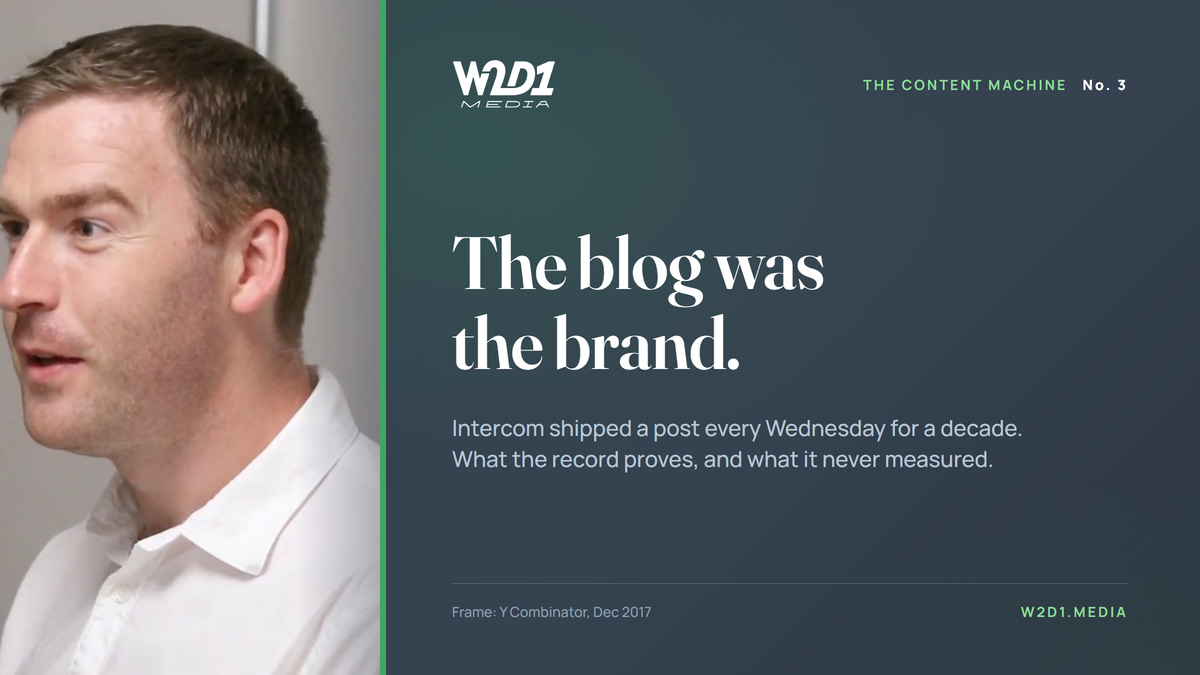
What he did next was write. In a Y Combinator interview the same month he said he wrote 93 of the blog's first 100 posts, that he started a blog "because that was the alternative to publishing", and that the approach was "content first, marketing second". The 2012 post states the rule the whole operation followed: "Everything you write should be crafted with the intention of selling, educating, or increasing customer loyalty." The posts were about product and design decisions, not about Intercom's features, which is why people who did not use Intercom read them.
John Collins joined in 2014 as managing editor after about twenty years in print journalism, per his own post that April. He named the blog Inside Intercom, kept the topics to "mostly a mix of product and design", and refused to publish "according to an artificial schedule". By February 2017 he told Fora the team was four, and by March 2019 it was nine across Dublin and San Francisco. By the time he left after about seven years, the writer Bobby Pinero counted roughly 1,200 posts, 200 podcasts and 12 books under him.
How the machine works
A fixed rhythm the founder built into the plumbing. Collins told the Superpath podcast in 2022 that Traynor had set up a feed so that "every Wednesday at five 30 an email would go out", which meant a post had to exist every week whether or not anyone felt like writing one. The podcast ran on Thursdays. Collins said listenership grew on the fixed schedule and grew again when the show moved from fortnightly to weekly. His own 2014 post rejected artificial schedules; the operation he ran was built on one. The difference is that the schedule was for shipping, not for topics.
The people who did the work wrote it. Posts came from product managers, designers and engineers, edited by journalists. That is why the blog could be about product and design in general rather than about Intercom, and why Collins could say, to Fora in 2017, "We don't constantly try to sell our product either." It is also why the hiring was editors and not marketers.
Posts became books, and books became sales collateral. The Product Management book was built from three years of posts, per Intercom's own description. Collins told Superpath he printed 10,000 copies, that "the sales team would go out in sales calls, they'd bring books", that they went to office visitors and conferences, and that the books were "a huge part of our marketing probably for about 18 months". They sold at roughly US$10 each and were "just about breaking even". The books were later turned into audiobooks. The same material was used three times, each time in a form that a different kind of reader would accept.
A podcast that started as a ten-episode test. Fora reported in 2019 that the show began in 2015 as a trial run, and by 2018 Collins called it "the fastest growing channel for us last year of all the things we do". By 2021 there were three shows. Intercom's podcast producer Liam Geraghty wrote the year-end summaries himself, which is another way of saying the content team was also the audience research.
The measurement was deliberately simple. Collins, on Superpath: "You shouldn't have to like, have really complicated like metrics or KPIs." He said to eyeball it and watch what people said back. Traynor, to Y Combinator, gave the one hard measure he was willing to: the blog "is our dominant traffic source." Collins also warned, in 2017, that "You'll only really see the benefits in two or three quarters." I could not find an email list size or a conversion figure published by Intercom in any year.
What it moves for the business
Here is the honest state of the evidence. Intercom's own speakers tie the content to three things: traffic (Traynor's "dominant traffic source"), brand (Collins: "content was our brand marketing for a long time", with PR and brand teams following "much later"), and recruitment (Collins, 2019: content is "a really powerful recruitment tool as well"). The podcast was the fastest-growing channel in 2018, by Collins's account. The books were central to marketing for a year and a half, by his account.
What the record does not contain is a number that joins any of that to revenue. The figure that circulates, that the blog generated more than a quarter of a million business leads, is a line in the show notes of a 2022 podcast that interviewed Collins. It is the host's copy, with no method and no quote, and I will not repeat it as fact. The claims that the blog took Intercom from US$1 million to US$50 million in ARR come from newsletters and chat threads with no source. Intercom did reach a US$1.275 billion valuation in 2018 and about US$400 million in ARR by 2026 on OnlyCFO's estimate, and content was its marketing for most of that run. That is a correlation the company's own people describe as a cause, and nobody has published the arithmetic.
I include Intercom anyway, and I am telling you why. Every other company in this column has a pipeline number because it built its content operation in the era when you could get one. Intercom built its operation when the honest answer to "what did the blog do" was "it is why people have heard of us", and its content lead said out loud that he would not pretend otherwise. If your own content is doing that job and you cannot prove it in a dashboard, this is the precedent.
The machine itself has changed. Marketing was cut in September 2022 and the company cut 13 percent of staff that November. The blog at intercom.com is live and now mostly about Fin and AI. Traynor announced a new, smaller blog in 2025 with "no marketing, no launches, no scheduled content", which now sits on a Substack under the Fin name. I could not find a dated ending for the podcasts, so I will not say they ended.
What to steal
Build the schedule into the plumbing, not the people. A send that goes out every Wednesday at half past five whether or not you have a post is how one post a week happens for ten years. Decide the slot first and the content second.
Let the people who do the work write, and hire editors to make it readable. Intercom hired a journalist, not a marketer, as its first content lead. The product people supplied the material and the editor supplied the standard.
Write about the problem, not the product, so people who do not buy from you still read. The blog was about product and design. The sales argument was that the company that writes this well about design probably builds well too. It was never stated in the posts.
Print the best of it and put it in the sales team's bag. Ten thousand books at break-even did more for Intercom's meetings than the same words on a screen. A physical object from a software company is a thing a buyer keeps.
If the honest measure is brand, say so and keep going. Collins waited two or three quarters for results and refused the complicated dashboard. If you need a pipeline number this quarter to justify a blog, you may be building the wrong machine.