
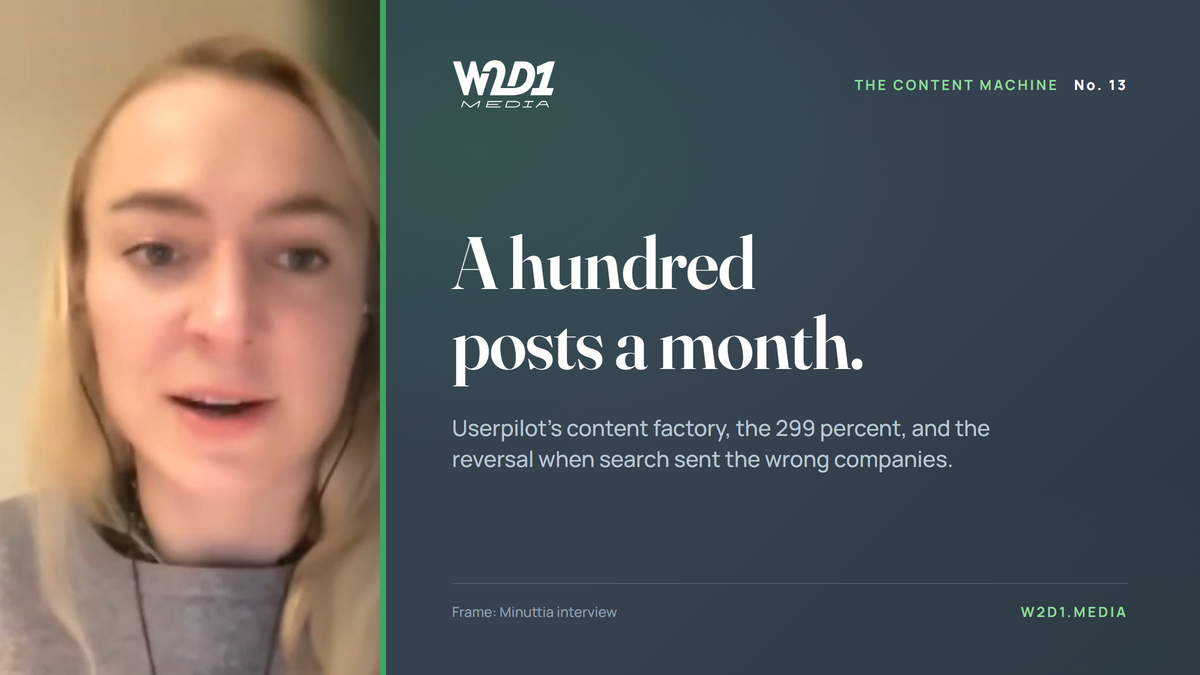
Userpilot's marketing lead was the only marketer at the company. Search brought 70 percent of sign-ups, so in 2021 she stopped everything else and built a content factory: a head of content, four editors, a proofreader and up to fifteen freelancers, shipping from four articles a month to fifty, then a hundred, then more. Organic visitors rose 299 percent. Then the blog peaked, AI answers ate the traffic, and the companies searching were the wrong size. Here is the machine and the rebuild, second-hand but dated.
The Content Machine is a column about startups and scaleups that run content as a system: what they make, how often, how it is reused, where it goes, who makes it, how it is measured and what it moves for the business. Userpilot is here because it built the most literal content factory in the column, documented how, and then, by its own marketing lead's account, found the factory producing the wrong customers. Nothing here comes from Userpilot's own site; it comes from the people who interviewed its marketing lead, and I have dated each figure to the account it sits in.
The premise
Userpilot sells product adoption software: in-app onboarding, surveys and analytics for software companies. It was founded around 2017 by Yazan Sehwail and Thabet Ghoraba, raised a US$4.6 million seed round in September 2022 after a US$1.2 million pre-seed, and has published no revenue or customer figures of its own that I could find. The sources disagree on where it is headquartered, so I am not saying.
The machine, in one paragraph. From 2021, a search-led content operation run by Emilia Korczynska, then head of marketing and now vice president: a blog split by funnel stage, plus hundreds of bottom-of-funnel comparison pages and lists generated from spreadsheets without code, produced by one head of content, four in-house editors, a proofreader and ten to fifteen freelance writers, briefed through a system of templates and task boards, measured on organic visitors and conversions by article and keyword. Output went from four articles a month to about fifty, and by her later accounts past a hundred. The one piece to look at is a current blog post, a product manager's playbook on adoption, which shows what the factory shipped at its best.
How it started
Korczynska was the only marketer at Userpilot in her first year, per a Databox case study on the operation published in 2024. The team tried paid advertising, webinars and events, she was stretched across all of them, and attribution was poor. The decisive input came from outside: she took a problem to John Bonini's content marketing community and was told to focus on what already worked. What already worked was search. "It drove 70% of signups at the time," the case study records. In 2021 the company committed fully to organic content, dropped the webinars and events, and set a target of going from four articles a month to forty. It reached fifty.
The second founding decision was about people. The in-house writers she hired kept leaving after a few months, wanting to grow beyond the role or burning out, and the case study records her conclusion: she "needed to build a better system rather than relying on better people". The system was briefs, milestones and hand-offs on a task board, with freelancers doing the writing and in-house editors holding the standard. That sentence is the whole philosophy of the operation, and it is also its limit, as the last section shows.
How the machine works
A funnel-shaped blog and a spreadsheet-shaped one. The editorial blog is organised by stage: top-of-funnel explainers, middle-of-funnel comparisons, bottom-of-funnel product pages. Beside it sits the programmatic layer, which Korczynska described at brightonSEO in April 2024 as hundreds of comparison posts and listicles built in Google Sheets without code. In February 2023 she had told the writer Harshal Patil that about a hundred such posts were converting at five times the rate of traditional posts; by her 2024 abstract the multiple was three times the blog overall. The multiples differ by a year and I give both.
The team is editors, the writing is freelance. One head of content, four full-time editors, a proofreader, and ten to fifteen freelancers found on LinkedIn and Medium, hired through an application form, samples and a timed editing test, per the 2023 account. No names are public beyond Korczynska's. The design is deliberate: writers are interchangeable, editors are not.
Volume, by date. Fifty articles a month, per the Databox account of 2021 onwards. "Over 100+ blogs published each month" in the February 2023 write-up. "From 4 to around 100 blog posts per month and counting" in her April 2024 speaker biography. "Over 130 blog posts a month" on a podcast in March 2024. No source says whether updates, programmatic pages or other languages are counted, so I report the sequence and not a single figure.
The tools are ordinary and the rules are specific. Ahrefs and Surfer for keywords and briefs, Asana for the pipeline, Google Analytics and Search Console for the measure, per the 2023 account. Link building ran to a domain-authority threshold first, then switched to relevance over volume, per Databox. On AI, Korczynska's 2023 position was that "AI-generated content is against Google Guidelines and might result in a penalty", and that she used it for ideas and research rather than articles; by 2026 she was using it to build landing pages. Nothing in the record says whether the hundred-plus posts a month were written with it.
Maintenance is a rule. Old posts are updated only once they are a year old, per the 2023 account, which also records about a thousand pieces accumulated over four years before maintenance began.
Measurement is by article and keyword, with a caveat the operator added herself. Dashboards show conversion rate by article, top keywords per article and top-converting keywords, per Databox. One finding from them: readers who consumed several top- and middle-funnel articles retained better as customers than those who converted off a single bottom-funnel page. In 2026 Korczynska told an agency podcast that last-touch attribution misses about 90 percent of conversions influenced by LinkedIn, with a 180-day window. The machine measured what search could show it.
What it moves for the business
The figures, with their sources. Organic search drove 70 percent of sign-ups before the 2021 commitment (Databox). About 18 months after it, "organic visitors grew by 299%, and conversions from organic search went up by 59%" (Databox). Programmatic posts converted at five times, then three times, the rate of the blog (Patil, 2023; brightonSEO, 2024). The blog "peaked at 235,000 visitors a month in May 2024" (an agency podcast summary, 2026). No absolute sign-up or revenue figure exists in any of it, and neither founder has said anything on the record about content and revenue.
Then the reversal, which is why this instalment is worth more than a success story. The agency Digital Hunch, which now works with Userpilot and has a commercial interest in the account, reported in 2026 that organic traffic to the site fell by roughly four fifths between January and April 2026, citing Ahrefs data, and attributed it to AI answers in search and to Google's changes. Its podcast with Korczynska records her verdict on the model she built: "We didn't control the size of the companies that were searching for particular keywords, so it was completely random." The company moved upmarket, and the marketing moved to account-based programmes on LinkedIn. She also said that a handful of bottom-of-funnel posts still carry most of the content revenue and that inbound still brings in significant business. The factory did not fail. It produced customers of the wrong size at a cost that stopped making sense when the traffic went.
What to steal
Find the channel that already works and stop doing the rest. Seventy percent of sign-ups from search was the signal. Userpilot cut webinars, events and paid to feed it. The hard part was the cutting.
Build the system before you hire better people. Briefs, templates, milestones, editors who stay, writers who rotate. Korczynska's line about systems over people is the most transferable sentence in this column, and the most dangerous if you forget the next one.
Count who converts, as well as how many. Three years of volume produced customers the company could not choose. Add the size and fit of the converting company to the dashboard before you add the hundredth article.
Put a maintenance rule in writing. A thousand pieces in four years with no updates until a post turned one. Decide the rule on day one, because by year three it is too late to apply it to everything.
Expect the channel to change, and keep the second one warm. Search sent the traffic; AI answers took it; LinkedIn is the rebuild. The operation that survives is the one that measured search honestly enough to know when to leave it.