
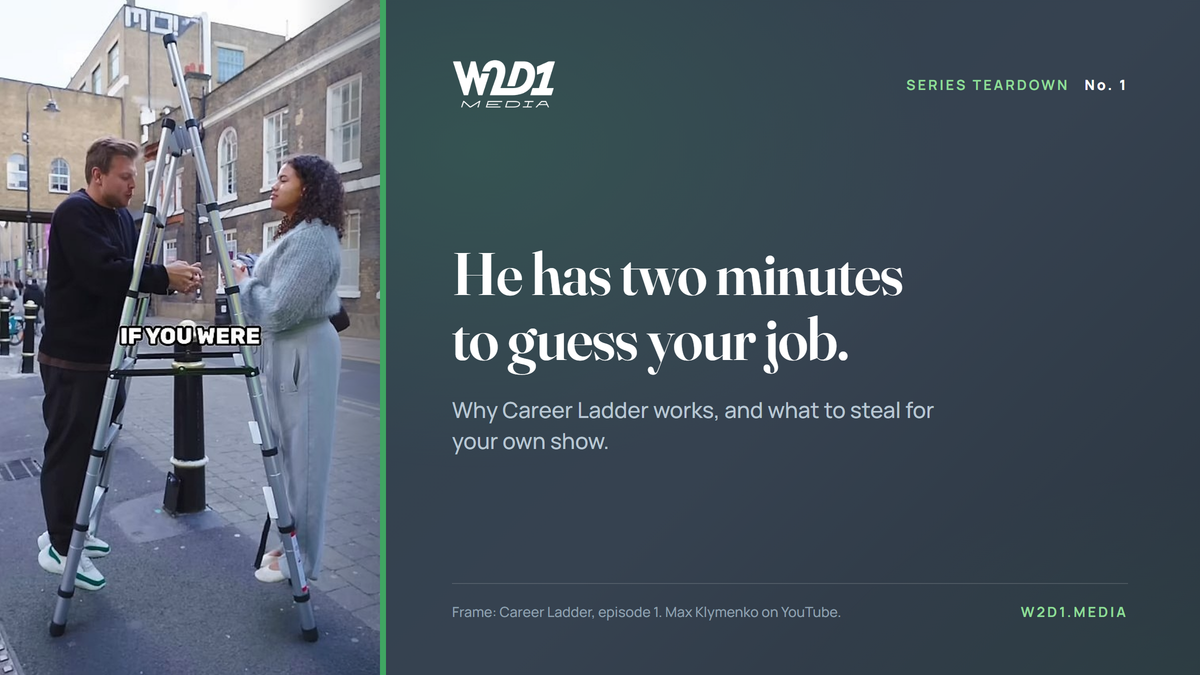
A man on a ladder guesses a stranger's job in two minutes. That is the whole show. Here is where it came from, why it holds, what it costs to make, and what a founder or a fund can take from it.
Series Teardown is a column about content series that are unusual in format and have the evidence to show they work. One series per piece. The story of how it started, the mechanics underneath it, the production reality nobody posts about, and what you can take from it for your own show. First up: Career Ladder.
The premise
Max Klymenko stands on the back rungs of a stepladder. A stranger climbs the front. He has about two minutes of questions to guess their job, and their answers are the only clues he gets. Then the reveal, and the next person.
Every episode runs the same way. There is a countdown, a run of rapid questions, a guess, a reaction, and the reveal. The format has a jingle that viewers sing back in the comments. Episodes are numbered, and by late 2026 the numbering on TikTok had passed 600.
That is it. A ladder and a timer. If you have never seen one, start where the show did: Career Ladder, episode 1, on YouTube.
How it started
Klymenko is Ukrainian, born in 1995. He moved to the UK in 2015 and, by his own account in the Washington Post Creator newsletter from August 2026, struggled to find work. He trained as a lawyer and worked as a consultant before going full-time on content. One detail from that piece stuck with me. Early on he started a podcast as an excuse to interview an employee at a company that had rejected him four times. He asked the guest for a job. The company eventually hired him. He later left to make content full time.
So the person behind the format is someone who spent years on the wrong side of a careers process. That matters for what the show became.
According to the Shorty Awards entry his team submitted, the idea came out of a brainstorm on a bus. The question was how to talk to people about their jobs without the usual bias: what they look like, how much they earn, what their title is, where they live. Early versions included blindfolding himself or having the guest face away. The ladder came from seeing two construction workers. He bought one, decided standing on it in public was too embarrassing, and it sat in the office for about two months. Then another shoot fell through, and the ladder was there.
The first episode went up on TikTok in early May 2024. The caption called it a test of a new format and asked for suggestions. The Shorty entry and the LBB Online case study both record that at the start he had trouble getting strangers to climb up at all.
Two years on, per the Shorty entry, the series had passed 600 million views a month and 3 billion views in total. Those are the creator's own numbers, submitted with the award entry, and I have no way to check them. The things I can check: the series won the TikTok category at the 18th Shorty Awards, was a finalist for Video Series, took the Audience Honor in TikTok, and was the reason he was named TikTok's Creator of the Year in 2025. Wikipedia's figures in July 2026 were 9.7 million TikTok followers and about 4.4 million YouTube subscribers. Penguin, which has his book listed for 2027, says more than 16 million followers across Instagram, TikTok and YouTube. The counts differ because they are counting different things on different dates, and I am not going to pretend they reconcile.
Why it works
Here is what I think is actually doing the work.
The constraint became the brand. He wanted to shoot vertical. A standing interview in a vertical frame is two faces and a lot of wasted pixels. The ladder solves that. It stacks two people in a tall frame and gives them something to do with their hands. It also, by accident, became the thing people recognise. When he filmed in Singapore in November 2025, Mothership's headline called him the Career Ladder guy, not Max Klymenko. The object is doing the job a logo normally does. Most people treat a technical constraint as something to work around. He built the show out of it.
The audience is playing too. This is the one most people miss. The structure is a game with a reveal at the end, and the viewer gets the same clues at the same time as the host. So you are not watching an interview. You are guessing alongside him, and you are usually wrong, and that is the fun. The Shorty entry describes it as guess, react, reveal, and says children play it at school. Any format where the viewer has a job in the first five seconds will hold better than one where the viewer is a spectator. Career Ladder gives you a job before the guest has finished climbing.
The premise is an opinion, not a theme. Bias removal is the whole point of the show, and it is built into the mechanics rather than stated in a caption. The guest is a stranger. The clues are their answers. The reveal is where the viewer's assumption meets the fact, and the viewer is usually the one who looks silly. A softly spoken young woman turns out to race in a Lamborghini series. Other guests the entry lists include a UN director of outer space affairs, a professional chocolate taster and an ethical hacker. The format refuses to let the audience judge by appearance, and that refusal is the show's point of view. A series with a point of view is far harder to copy well than a series with a topic. Wikipedia records that the format was copied by numerous creators, and most of those copies feel like the same gag without the reason behind it.
The post rate is brutal. The LBB case study, repeated in the Shorty entry, says nearly 3,000 interviews had been filmed and only a few hundred posted. Call it one in ten, give or take. The team films several days a week for about seven hours a day. So the finished product you see is the top decile of a very large pile. Most creators post what they shoot. He shoots, then chooses. The consistency that people read as effortless is a selection effect.
The format survives a bigger guest. The same mechanic holds for a stranger outside a temple, the chief executive of Grab, a UK prime minister and a government intelligence agency. For famous guests the game shifts to guessing their first job, which keeps the puzzle intact when the current job is obvious. In March 2026 GCHQ put out a run of Career Ladder episodes filmed inside the organisation. In June 2026 Cannes Lions ran a live version on stage. The format scales up without changing shape, which is what lets a creator series become a commercial property. CAA signed him in May 2026. The book is based, per Penguin, on interviews with more than 2,000 people.
What it costs to make
This is the part the clips do not show, and it is the part worth sitting with if you are tempted to copy the model.
Seven hours of filming, several days a week. Thousands of conversations with strangers, most of which nobody will ever see. A crew that has to find and persuade people to climb a ladder in public, in a new city, and do it again tomorrow. A world tour across 130 countries that, by August 2026, had been paused. None of that is visible in a 90-second episode, and all of it is the reason the 90-second episode is good.
The hit rate is the number I keep coming back to. If one in ten filmed conversations is worth posting, then a creator who films ten a week and posts all ten is competing against someone who films a hundred and posts the best ten. They are not making the same product, even though the format is identical.
The other cost is the first two months. The ladder sat in an office because its creator thought he would look stupid on it. The first episode was captioned as a test. Early strangers would not climb up. The format that now defines a category looked, for its first few weeks, like a man standing awkwardly on a ladder asking passers-by for a favour. If he had judged it at episode five, there is no show.
What to steal
Pick one physical constraint and keep it for a hundred episodes before you judge it. The ladder is a frame solution that became an identity. Your version might be a specific room, a specific prop, a fixed camera angle, or a fixed run time. The point is that the constraint has to be visible and has to be the same every time, so that recognition does the work your budget cannot.
Give the viewer a job in the first five seconds. Not a hook, a job. Guess the answer, or pick a side before the guest does. A podcast can do this too: a question posed to the listener at the top that the guest is about to answer, and that the listener has to commit to first. Participation beats spectating for retention, and it costs nothing.
Film more than you post, and tell your team the ratio up front. Career Ladder posts roughly one conversation in ten. You do not need that ratio, but you need a ratio, and you need everyone involved to know that most of the work is meant to be discarded. If every recording has to ship, you will ship average recordings.
Decide what your format refuses to show. Career Ladder refuses to let the viewer see income, status or location before the guess. That refusal is the show's opinion, and it is why the copies feel hollow. Ask what your show will not do. No warm-up questions, say, or no guest pitching their company. The refusal is where the point of view lives.
Build it so a bigger guest does not break it. The first-job variant is a small design decision that let a street format hold a prime minister. If your show only works with a certain tier of guest, it will stall when you move up or down a tier. Test the format on the least famous person you can find and on the most famous, and fix whichever end snaps.
Sources
- Shorty Awards, 18th annual, entry for "The Career Ladder" (Max Klymenko, represented by Sixteenth UK): https://shortyawards.com/18th/the-career-ladder. Winner, TikTok category; finalist, Video Series; Audience Honor, TikTok. Origin story, production cadence, filmed-versus-posted figures, and the view claims.
- Wikipedia, "Max Klymenko", as revised 29 July 2026: https://en.wikipedia.org/wiki/Max_Klymenko. Biography, 2024 start date, follower counts, awards, and the statement that the format was widely copied.
- Washington Post Creator, "Verified: Climbing the Career Ladder", Dylan Wells, 12 August 2026: https://wpcreator.washingtonpost.com/p/verified-climbing-the-career-ladder. Early career, the podcast-as-job-application story, the construction-worker origin of the ladder, the two months it sat unused, the first-job variant for famous guests, the paused world tour.
- GCHQ, "Content creator Max Klymenko explores secret world from his Career Ladder", 24 March 2026: https://www.gchq.gov.uk/news/content-creator-max-klymenko-explores-secret-world-from-his-career-ladder.
- Mothership, "'Career Ladder Guy' visits S'pore, meets Grab CEO & local creators", 7 November 2025: https://mothership.sg/2025/11/career-ladder-guy-sg/.
- Penguin Books Australia, listing for The Career Ladder by Max Klymenko: https://www.penguin.com.au/books/the-career-ladder-9781804964194. Follower total, Creator of the Year, the 2,000-interview basis for the book, and the 2027 publication dates.
- Self Evidence, "Why Max Klymenko's Career Ladder Format Works: A Psychology Breakdown", December 2025: https://www.playselfevidence.com/2025/12/why-max-klymenkos-career-ladder-format.html. One commentator's reading; used only for the Lamborghini race-driver episode detail.
- Cannes Lions 2026 programme, "Career Ladder Live: I'll guess your job": https://www.canneslions.com/festival/experiences/lions-creators/programme/career-ladder-live-ill-guess-your-job-e1-72248.
- Max Klymenko on TikTok, episode 1, posted May 2024 (date derived from the post ID): https://www.tiktok.com/@maxklymenko/video/7365674616523672864.
- LBB Online, "Max Klymenko - Career Ladder" case study: https://lbbonline.com/work/163161. Cited only where the Shorty Awards entry repeats its figures.
- Deadline, "CAA Signs Max Klymenko, 'The Career Ladder' Creator & YouTuber", May 2026: https://deadline.com/2026/05/caa-signs-max-klymenko-the-career-ladder-creator-1236899154/. Headline and date only.