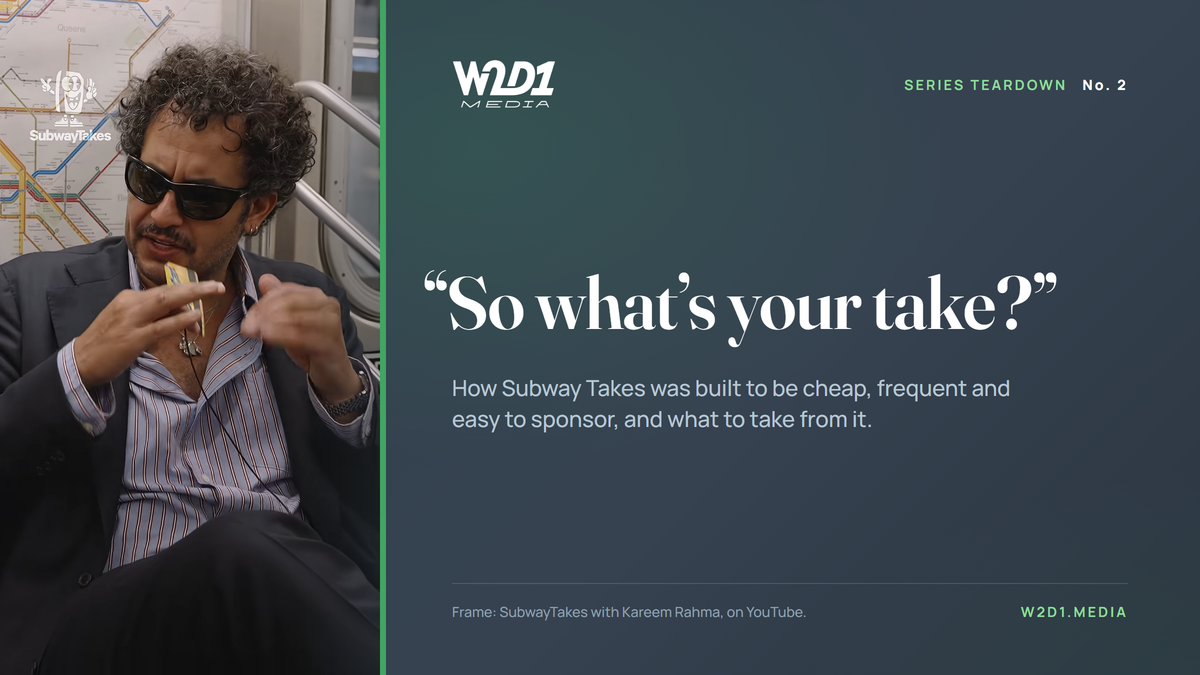
A microphone clipped to a MetroCard, a guest on a New York train, one question: what's your take? Kareem Rahma built a show that is cheap to make, impossible to pad and easy to sponsor. Here is how, and what to take from it.
Series Teardown is a column about content series that are unusual in format and have the evidence to show they work. One series per piece: how it started, the mechanics underneath it, the production reality nobody posts about, and what you can take from it for your own show. The first instalment was Career Ladder. This one is Subway Takes.
The premise
Kareem Rahma sits on a New York subway train in an oversized suit and dark sunglasses. Next to him is a guest, sometimes a commuter, sometimes a comedian, sometimes Cate Blanchett. He holds up a MetroCard with a small microphone clipped to it and asks one question: "So what's your take?"
The guest states an opinion and defends it. Bacon is a spice. Good singers should not do karaoke. Owning a dog does not make you interesting. Rahma pushes back, agrees, boos or hypes, and then rules on it. Wikipedia records the signature verdict as "100 percent agree" or "100 percent disagree". The train keeps moving the whole time. An episode runs about 90 seconds, per Rolling Stone's count in March 2025, and by October 2026 the numbering had passed 800.
That is the entire show. A card, a question and a verdict. For a typical episode, watch the caffeine-free Red Bull take on YouTube, about 90 seconds with a creator guest.
How it started
Rahma was born in Cairo in 1986 and grew up in Minnesota. Before he was on camera he was behind the numbers: head of audience development at Vice, then growth editor at the New York Times, where Wikipedia credits him with producing the paper's first vertical video. He co-founded a podcast company with Andrew Kuo in 2021. He had already made a pop-up pizza museum and a haiku collection. The point is that Subway Takes was not a first attempt. It was the format that finally landed after a decade of trying things.
The one just before it was Keep the Meter Running, from 2022, where he rode in taxis to the driver's favourite place in the city and paid the full fare. It got him into Vanity Fair. It also, by his own account to Rolling Stone, cost him about US$2,000 an episode out of his own pocket. He wanted something that gave him the same buzz without the bill.
The idea came sideways. Rolling Stone describes friends pitching him podcasts that were really about the clips, so he proposed the obvious thing: a podcast that was only clips, with no full episode behind them. Kuo suggested filming on the train. Rahma told the magazine it felt like being mischievous. The first episode went up on 31 July 2023, per Wikipedia. The New York Times later described the pair as having created it almost as a whim, and as a gamble that it could earn money.
It did. By early 2024 output had gone from two episodes a week to four. In August 2024 the Democratic presidential ticket, Kamala Harris and Tim Walz, sat on the train. Harris went off her pre-agreed take, offered "bacon is a spice" to a host who does not eat pork, switched to anchovies on pizza on a staffer's advice, and the campaign later apologised and offered a reshoot. Rahma declined, and the episode never ran. The Times reported all of it in November 2024. I will come back to that decision, because it is the most instructive thing in the whole story.
The evidence that the format works is now hard to argue with. In July 2026 the show was nominated for an Emmy for outstanding short form comedy, drama or variety series. TheWrap called it the first creator-led, YouTube-backed show to get one. Rahma made the TIME100 Creators list in both 2025 and 2026 and signed with UTA in 2026. CP24 put the YouTube channel at more than 1.1 million subscribers and more than 800 million views in September 2026, and Adweek had the Instagram account above 2 million followers. There are spin-offs filmed in Chicago, London and Berlin, a long-form podcast with Talkhouse since February 2025, and a Toronto series of about 15 episodes made with YouTube Canada, the first of which went up in October 2026.
Why it works
Here is what I think is doing the work.
The take is a constraint, not a topic. Most interview shows have a subject and hope something interesting comes out of it. Subway Takes has no subject. It has a shape: one opinion, defended, then judged. That shape does two things. It forces the guest to commit, which is where the entertainment lives, and it forces the viewer to pick a side in the first ten seconds, which is where the retention lives. Rahma told W Magazine that the more ordinary the take, the better the segment tends to be, and called it "the most sophisticated show about the stupidest subjects." Northeastern's media academics, writing about the show in August 2026, put it more formally: a take works when it mixes enough controversy with an honest observation about everyday life, and it dies when it feels manufactured.
The train supplies the clock. Rolling Stone identified the main draw as the fact that everyone on a subway has somewhere to be. The setting gives every episode motion, noise, an audience of strangers and a natural end point. You cannot pad a conversation on a moving train. The location does the job a producer's stopwatch normally does, and it does it for free.
It was built to be sold before it was built to be big. This is the part founders should read twice. Rahma has told Axios that the show was designed to be easy to understand from a sponsorship standpoint, and that brands come in as a take or a product placement rather than as an ad read. He has said branded episodes routinely draw the same views as organic ones, and sometimes more. Wikipedia lists paid takes from Google, Microsoft, Hulu, StreetEasy and H&M, and guest outfits sponsored by H&M, Urban Outfitters, KOTN and J. Crew. On the Google deal he described developing the take together with the brand and the talent. The sponsorship slot is not bolted onto the format. It is the format.
Cheap on purpose, so it can be frequent. Rolling Stone reports that two camera operators are enough to film it, which is what let him double the weekly output. TheWrap adds that several episodes are often shot in a day and that the editors, producers and sound engineers mostly come from film and television. Compare that with US$2,000 of taxi fares per episode on the show before. He did not get a bigger budget. He built a show that did not need one, and then spent the saving on volume.
He says no, loudly. At Adweek's Social Media Week he said he has always pushed against changing the show or adding variations, and that he wants its DNA to stay mostly independent comedians rather than celebrities. He told Rolling Stone he only books people he wants to talk to, and that he is his own first audience. And he binned an episode with the Vice President of the United States because it was not good enough. Every one of those refusals costs reach in the short term. Every one of them is why the format still means something 800 episodes in.
What it costs to make
The clips look like a man with a card on a train. The operation behind them is not that.
A crew of several people, including sound, on a working subway line where interruptions and scrambled audio are routine, per TheWrap. Several episodes a day to hit four a week, which over three years is roughly 800 published edits, each one cut from a longer conversation. A long-form podcast on top. Spin-off shoots in four other cities. A Toronto season with a broadcaster partner. Rahma estimated to TheWrap that around 150 people work across the six creator shows YouTube backed for Emmy consideration this season, his among them. "We are working all the time," he said.
The costs that do not show up on a call sheet are the ones I would weigh. Ten years of formats that did not become this one. A previous show that was bleeding US$2,000 an episode. A host who wears a disguise on camera, by his own description, because the character does work the person could not. And the Harris decision: the largest guest the show will ever get, recorded and deleted, because running it would have told the audience the format bends for power. It does not, and that is now part of what the show is worth.
What to steal
Make the clip the product. Do not record an hour and hope to mine it. Rahma's founding pitch was a podcast of clips with no episode behind them. Decide the unit of your show, 90 seconds or 20 minutes, and design everything for that unit. Anything longer is raw material, not content.
Put a verdict in the format. The take is only half the engine. The ruling is the other half. Give your host a mandatory call at the end of every segment, a score, a yes or no, a ranking, so that every episode has an outcome the audience can argue with in the comments. Open questions get fewer comments than closed ones.
Price the format for the cadence you want, not the other way round. Rahma worked out what two episodes a week cost, found a way to film with two cameras, and used the saving to go to four. If your show cannot afford weekly, do not make a weekly show with less care. Make a cheaper show.
Design the sponsor slot before you need a sponsor. A brand should be able to appear as a piece of the format, not as an interruption to it. Work out what that looks like on episode one, when there is no money on the table, so you are not inventing it under pressure on episode 40.
Keep the right to say no. The format is the asset. Every guest who wants to bend it, every brand that wants a different version, every opportunity to make it bigger by making it looser, is a withdrawal from that asset. Rahma's refusals are the clearest signal in this whole story that he understands what he owns.
Sources
- Rolling Stone, "'Subway Takes' Is a TikTok Hit. Kareem Rahma Planned It That Way", CT Jones, 26 March 2025, read via Yahoo syndication: https://www.yahoo.com/entertainment/subway-takes-tiktok-hit-kareem-173248672.html. Origin story, the US$2,000 figure, two camera operators, two-to-four episodes, guest selection, the subway's urgency, episode count and length, quotes.
- Wikipedia, "SubwayTakes", as of October 2026: https://en.wikipedia.org/wiki/SubwayTakes. Launch date, the MetroCard microphone, the "100 percent" verdict, the Harris episode as reported by the New York Times, sponsors, spin-offs, the Talkhouse podcast.
- Wikipedia, "Kareem Rahma": https://en.wikipedia.org/wiki/Kareem_Rahma. Biography, earlier projects, Keep the Meter Running, awards.
- TheWrap, "'SubwayTakes' Host Kareem Rahma Hopes His Emmy Nom Can Help TV's Future", Kayla Cobb, 8 July 2026: https://www.thewrap.com/creative-content/tv-shows/subway-takes-emmy-nomination-kareem-rahma-andrew-kuo-intervew/. Emmy category, crew and shooting conditions, the 150-person estimate, quotes.
- Tubefilter, "'Subway Takes' earns Emmy nomination as YouTube's push (sorta) pays off", 8 July 2026: https://www.tubefilter.com/2026/07/08/subway-takes-earns-emmy-nomination-as-youtubes-push-sorta-pays-off/.
- TIME, "Kareem Rahma Is on the 2026 TIME100 Creators List", 14 July 2026: https://time.com/collection/time100-creators/2026/kareem-rahma/. Also the 2025 listing: https://time.com/collections/time100-creators-2025/7299143/kareem-rahma/.
- Adweek, "Why Refusing to Change the Format Led Subway Takes to Viral Success", Alison Weissbrot, from Social Media Week: https://www.adweek.com/social-marketing/subway-takes-viral-success-kareem-rahma-reza-izad/. Quotes on refusing to change the format; Instagram follower figure.
- Axios, "Kareem Rahma of 'Subway Takes' on how brands can tap the creator economy", 12 December 2024: https://www.axios.com/2024/12/12/kareem-rahma-subway-takes-brands. Sponsorship design and the branded-versus-organic views claim.
- W Magazine, "Kareem Rahma Is a Man of Many Takes", Claire Valentine, 13 October 2025: https://www.wmagazine.com/culture/kareem-rahma-subway-takes-interview. Quotes on ordinary takes and the show's tone.
- Northeastern Global News, "The Art of the Take: Inside Kareem Rahma's Viral SubwayTakes", 5 August 2026: https://news.northeastern.edu/2026/08/05/subwaytakes-art-of-the-hot-take/. Academic reading of why takes work; 750 million YouTube views figure.
- CP24, "Toronto, what's your take? YouTube series 'Subway Takes' coming to the TTC", 17 September 2026: https://www.cp24.com/news/entertainment/2026/09/17/toronto-whats-your-take-youtube-series-subway-takes-coming-to-the-ttc/. Subscriber and view figures, Toronto season details, spin-off cities.
- blogTO, "Viral 'SubwayTakes' show released its first Toronto episode", October 2026: https://www.blogto.com/city/2026/10/subwaytakes-toronto-first-episode/. Episode 811.
- Variety, "'Subway Takes' Host Kareem Rahma Signs With UTA", 2026: https://variety.com/2026/digital/news/subway-takes-kareem-rahma-uta-1236785198/. Headline and date only.
- The New York Times, "Kareem Rahma's American Dream", Reggie Ugwu, 4 November 2024. Its reporting on the show's origin and the Harris episode is cited here as carried by Wikipedia and Rolling Stone.