
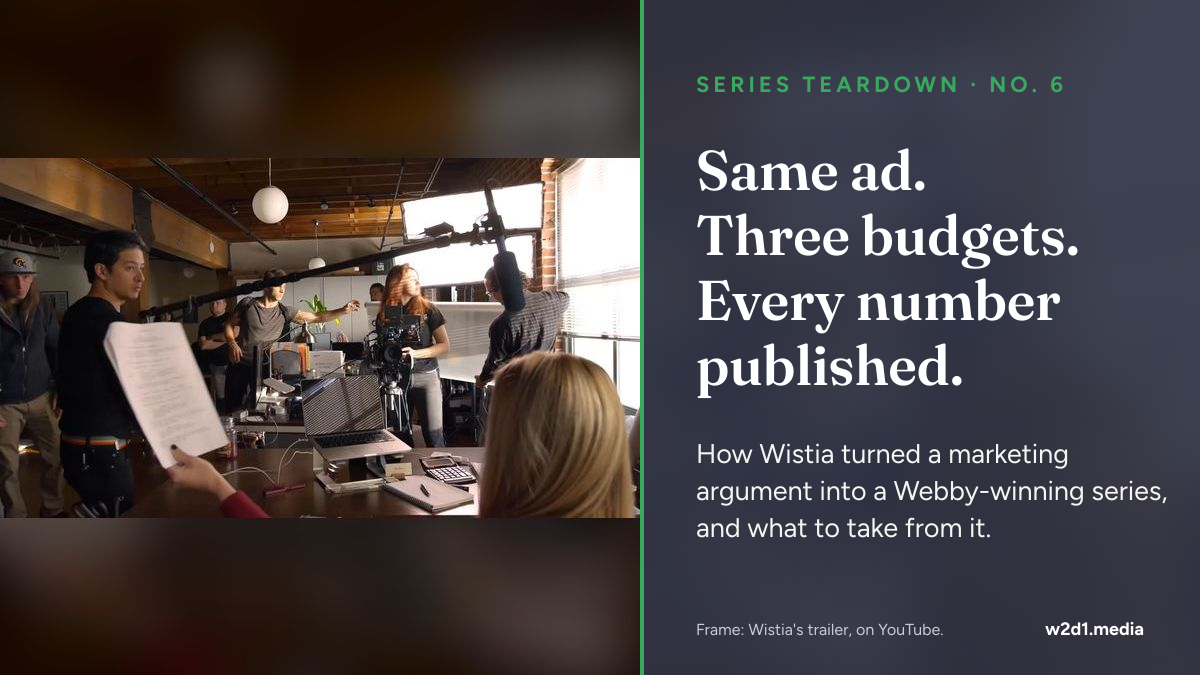
A video software company asked a question every marketer has: does a bigger budget make a better ad? It paid an agency to make the same ad for US$1,000, US$10,000 and US$100,000, ran all three with identical spend, published every number, and filmed the whole thing. The $10,000 ad won. The documentary won two Webbys. Here is what to take from it.
Series Teardown is a column about content series that are unusual in format and have the evidence to show they work. One series per instalment: how it started, the mechanics underneath it, the production reality nobody posts about, and what you can take from it for your own show. The first five were creators and publishers. This one is a B2B software company, and it is the instalment I would hand to any founder who says "we should do a video series" without saying what the series is for.
The premise
In 2018 Wistia, a video hosting company in Cambridge, Massachusetts, hired Sandwich Video, the agency behind most of Silicon Valley's product launch films, to make three ads for its screen-recording tool Soapbox. Same brief, same product, three budgets: US$1,000, US$10,000 and US$100,000. Then Wistia ran all three as paid campaigns with equal spend on Facebook and YouTube, measured them to the cent, and published the results. A four-part documentary, One, Ten, One Hundred, followed the whole thing from the pitch to the blockbuster shoot.
The show was not about the ads. It was about the question. Watch the series trailer on YouTube; the full episodes live on Wistia's own site.
How it started
Wistia is a 2006 company founded by two Brown graduates, Chris Savage and Brendan Schwartz, in Schwartz's living room. In 2017, per its own account, the founders raised US$17.3 million in debt to buy the company back from their investors, because they wanted out of growth at all costs and into a slower business built on customers succeeding with video. Foundr's 2024 account of the buyback has the numbers: projected earnings before interest and tax of minus US$3 million in 2017, plus US$6.3 million in 2018. That swing is the background to everything that followed. A company that has just bought itself back, and just become profitable by cutting, has to find a cheaper way to be known. Schwartz's explanation of the series, to Foundr, was four words: "This is what we wanted to watch."
The series came from a gap the production team admitted to. Wistia's launch release in September 2018 says the team "didn't have a good understanding of the money-in-money-out ratio" for video, which is a remarkable thing for a video company to say out loud. Savage's position, in the same release, was that creativity mattered more than budget and that the experiment should prove it. There was also a reason he gave to the trade press for the format itself: video marketing had been all short-form, and breaking through meant trying something long. And there was a commercial reason underneath both. The three ads were real ads for a real product, Soapbox, and the test spend was real money.
The results went out on 14 November 2018. The documentary premiered at an event in Boston in October and was released as four episodes: the pitch, the US$1,000 film, the US$10,000 film and the US$100,000 film. In April 2019 it won the Webby for best video series in branded entertainment, taking both the judges' award and the people's voice. Wistia's about page counts that as two Webbys. It then built a studio around the idea: Brandwagon, a talk show hosted by Savage, in 2019; Show Business, a series about making shows, after that; and Talking Too Loud, his podcast, which is still running in 2026.
Why it works
Here is what I think is doing the work.
The question is one the audience already has. Every marketer who has ever briefed a video has wondered whether the extra money shows up on screen. Wistia did not invent a topic. It picked the argument its customers were already having and staged it with real stakes. That is the difference between a brand series and a brand ad: an ad answers a question nobody asked.
The experiment is the content, and the product is the subject. The three films were ads for Soapbox. The documentary was about making ads for Soapbox. The results were about how ads for Soapbox performed. At no point did the series have to find a way to mention the product, because the product was the test material. Wistia's launch release makes the point itself: the company ran the experiment on its own product to avoid the fakery of other social "experiments". Per the November release, Facebook drove a 234 percent increase in searches for Soapbox during the campaign.
They published the number that made them look ordinary. The US$10,000 ad won. On YouTube it cost US$6.66 per install against US$12.74 for the US$1,000 film and US$10.75 for the US$100,000 one, per the results release, and it beat the other two on Facebook by a wider margin. The expensive film, the one with the Hollywood crew the documentary spent an episode on, came last on Facebook at US$77.54 per install. Wistia printed that. Savage's reading was that the middle budget "struck the right balance" between polish and authenticity, and that the cheap film matching the expensive one meant the idea mattered more than the money. A production professional, Brian Chin, published a critique arguing the test was designed to land on that answer. Both can be true. The point for a brand series is that the receipts were public either way, and the critique is itself evidence that people engaged with the method rather than the marketing.
Depth was the metric, not reach. Wistia's own post on the Webby, by Phil Nottingham in April 2019, concedes that Uber's branded series got nearly ten times the views of episode one. Then it makes the argument the whole series rests on: average viewing time of 43.5 minutes across a 90-minute series, branded search up 11 percent since launch, and "many thousands" of email addresses captured, because the episodes lived on Wistia's own site behind an email gate rather than on YouTube. His line: "the number of impressions is not the number of people impressed." Foundr reports that in the first six weeks viewers spent more time on Wistia's channels than during all of the previous year's marketing, and that the series led to hundreds of new customers. For a B2B company with a long sales cycle, 43 minutes with a prospect is worth more than a million three-second views.
They turned one series into a studio. The second show, Brandwagon, reported in its Shorty Awards entry 36,000 series views, 6,300 subscribers, an average watch time of 8 minutes 20 seconds, 1.2 million views of clips and trailers, and viewers three times more likely to return to wistia.com than non-viewers, all in its first four months. Repeat visits were bought by retargeting episode-one viewers with the next trailer for just over a dollar each. A series is expensive once and cheap every time after, if the first one taught you the system.
What it costs to make
The ads alone cost US$111,000 to produce, plus a US$60,000 paid test over three weeks per Wistia's own breakdown, plus a four-part documentary with a crew following an agency for months, plus a Boston premiere, plus the results report. For a company that had just borrowed US$17.3 million to buy itself back, that is not a small bet on a question.
The second cost was the discipline of measuring honestly. Wistia set a cost-per-install target of US$8 and missed it on every ad on Facebook. It published that too. A sequential ad format cost US$281 per install and was paused halfway through; that is in the write-up as well. A brand series that only reports the wins is an ad with extra steps.
The third cost is the one that makes this format rare: the willingness to let the expensive thing lose. Most companies that spend US$100,000 on a film will tell you it was worth it. Wistia's documentary spent its longest episode on the blockbuster shoot and then reported that the US$10,000 film beat it. That costs something in pride, and it is exactly what bought the credibility.
What to steal
Stage the argument your customers are already having. Do not invent a topic for your series. Find the question your buyers argue about in their own meetings, and run the experiment they cannot run themselves.
Make your product the test material, not the sponsor. If the thing you sell is the subject of the experiment, the series never has to pause for a plug. If it is not, it will, and viewers can feel the pause coming.
Publish the receipts, including the ones that embarrass you. The number that made Wistia look ordinary is the number that made the series trustworthy. Report the target you missed.
Host it where you can measure depth. Put the full episodes on your own site behind an email, and use the platforms for trailers and clips. You cannot email a YouTube subscriber, and a 43-minute average watch time is a sales conversation, not a view.
Plan the second series while making the first. The expensive part of One, Ten, One Hundred was learning how to make a show. Brandwagon reused the system and reported results in four months. Budget the first series as tuition, and decide what the second one is before the first one ships.